- Homepage
- Wheat bread
- Special plant nutrients in wheat
- What Is the Healthiest Type of Flour
What is the healthiest type of flour?
What is the healthiest type of flour and can those with gluten issues really eat sourdough bread?
Healthy flour is only to be had really if you have your own grinder. They are expensive but, after 25-years our Hawo mill has paid for itself many times over; it is used virtually every day.
Does flour go bad? Yes, it certainly does. Rancid might be a better word because of the labile-oils in wholewheat. There is only one way to enjoy the real stuff that I know of and that's to grind your own; you are unlikely to find it on the supermarket shelves.
Wwellness will jump to new heights when you start baking
with true wholemeal, grinding your wheat-berries but not becoming neurotic about
it.
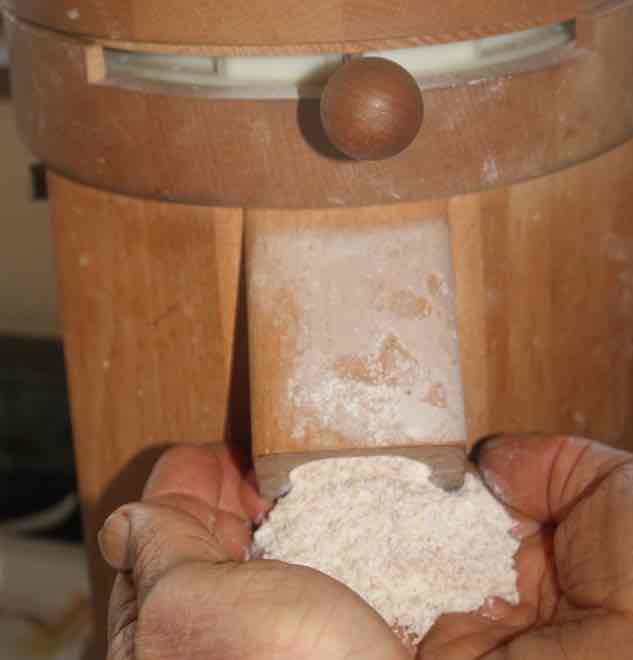 No separation of the three streams
Quick guide
No separation of the three streams
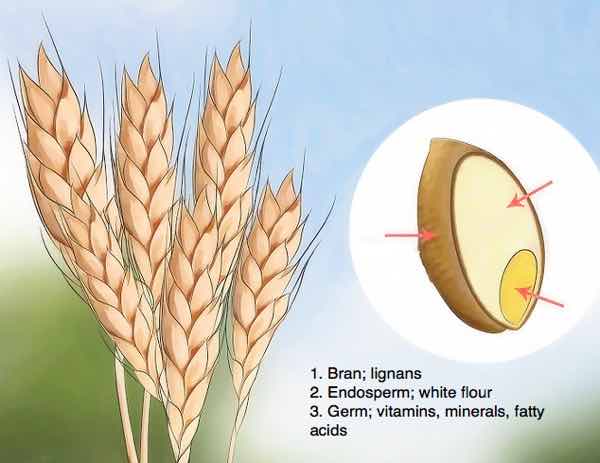
True wholewheat must contain the entire seed in the same proportions that nature gives it to us. That means all of the endosperm from which white flour is made and one hundred percent of the bran which is the fibrous part containing the lignans that help prevent malignant breast disease; and the vitamins pyridoxine and niacin.
And thirdly it must contain all of the germ where most of the thiamine, folate and vitamin E are located; and the minerals and important oils. It is truly has pride of place in nature's pantry but has fallen into disfavour because refined flour is so detrimental to wellness; and freshly-ground wholewheat almost impossible to purchase.
This healthiest type of flour is truly from nature's pharmacy where so many important nutrients are found but you are unlikely to find it in the home pantry.
There is an alternative; here it is.
When wheat is refined the bran and much of the germ are extracted; all the fibre and a good portion of the protein, minerals and vitamins. Those are sold to pig-farmers who pay a premium for the best part of the grain. We are left with the empty, very fattening calories.
True food must contain both energy and nutrients; grocery store flour does not qualify.
"Nothing is less productive than to make more efficient what should not be done at all."
- Peter Druker
The material expressed on this page is gleaned from the nutritional and environmental literature; it is clearly referenced. A plain distinction is made between the author's opinion and that which is scientifically proven. When in doubt consult your health professional.
To suggest a correction or clarification, write to Dr Bernard Preston here. Contact.
Wheat grinders
There is only one other option that I can think of and it is too much schlep for me and probably you also. Go to a commercial mill and purchase a sack of freshly-ground 100 percent wheat flour and take it home; divide it up into smaller containers and freeze it.
It is impractical and for my money it is better to buy yourself a good wheat-grinder if you are serious about your welfare and have no desire to give up bread for ever; nor do you need to.
Why do I say good? Because the cheaper varieties will not grind it as finely as you probably would want your healthy flour. Do your homework before buying or you may be disappointed; more about that lower down on this page.
"There is hardly anything in the world that
some man cannot make a little worse and sell a little cheaper, and the
people who consider price only are this man's lawful prey."
- John Ruskin
They start at about 200 dollars and I was shocked to discover that our 25-year old Hawo now costs $700. It is all about your philosophy of life; are you going to put your money where your mouth is and enjoy nutritious choice foods, or are you going to spend it on going to doctors?
Healthy flour or supplements?
So what's it to be? Are you going to be sure of healthy flour or are
you going to pay for supplements? It has to be one or the other.
Healthy flour doesn't come cheap after paying for the mill but the alternative is that every month you will be forking out for vitamin E and omega 3 softgels, not to mention all the other goodies in your own home-ground wheat; the calcium and iron for example.
Interesting research reported in Internal Medicine, after following a huge group of doctors and nurses over 25 years, reveals that every extra slice of 100-percent wholewheat bread that you add daily to your diet results in a 9% decrease in mortality from heart disease[1].
The reason is probably largely to do with three nutrients called choline, betaine and vitamin-E; interesting research shows that they reduce important inflammatory markers.
That 9-percent is massive. Fewer than 5% of purchasing mainly from grocery stores are enjoying the recommended 3 ounces of whole grains per day. Is it any wonder that cardiovascular disease is the number one killer?
The healthiest type of flour must contain all these special plant nutrients found in wheat; no separation of the three streams.
Replace a refined starch with a whole grain
What's more is that simply replacing one portion of white-bread, with a slice of 100% wholewheat reduces not just heart disease but your overall mortality by 8 percent. Less of that other nasty too; a colorectal malignancy that today is ravaging younger people.
Reading the labels is important; make sure your breakfast cereals, bread and pasta state 100-percent whole wheat and don't be fooled by the colour or terms like multigrain. The millers cheat and will do anything to dupe you into buying an inferior product; the germ and bran they sell at great profit to the supplement companies and pig farmers. Expect to pay more; it is worth the extra.
More than 95% of Americans do not get the recommended minimum of three ounces (3 x 30g) of whole grains per day and are consuming less than a half of the recommended fibre of roughly 40 grams; don't be one of them. Malignant tumours of the intestine are awful and very common; around one-third of all neoplasms.
More fibre
Other research reported in the American Journal of Epidemiology reveals a 10% lower mortality with an increase of ten grams of fibre from our food; two slices of wholewheat bread, one serving of legumes like hummus and a helping of broccoli.
Researchers acknowledge that it's
probably not just the fibre in these whole foods that contribute to better
health.
Does flour go bad? What do the millers do to stop that? Easy, they extract the fatty fraction to increase the shelf-life and sell you that nutritious wheatgerm oil at ten times the price to protect your blood vessels from atherosclerosis; and the bran to cure your rabbit pellets.
Actually added extra bran is a bad way to deal with constipation; it adsorbes calcium and that's bad news for women.
Understanding the difference between wheat vs whole grain is vital; they are chalk and cheese.
And
interesting research proves that grandmother's recipe is better than
the best medical treatment anyway; three to six prunes a day. They are
trying to find a way to sell you the rich vein of phytosterols in
freshly ground wholewheat flour too; they keep the bad blood fats down and
protect the prostate gland.
So there are three options
- You can go out and buy a mill and find a good source of wheat.
- Or you can buy the vitamins, essential fatty acids and the bran; and the phytosterols normally found in healthy flour.
- Or you can go without and accept a significantly lower standard of wellness; and the cost that goes with it.
Heart disease rare prior to the refining of wheat
You probably think that I am radical. The eminent cardiologist Dr Wilfred Shute points out heart disease was almost unknown prior to the refining of wheat about a hundred and fifty years ago. He attributes it to the anti-coagulating properties of the tocopherol, vitamin E.
So cooking with wholemeal implies you have access to freshly-ground healthy flour.
Do not bother baking with old wholewheat meal; the rancid fatty-acids are probably more detrimental to your body than the insulinaemic properties of refined grain are damaging.
Certainly demand that the whole wheat flour has a date printed on the bag stating when it was ground; more than a week is a problem unless frozen. Mill it yourself.
However there are other considerations when it comes to making your own healthy flour. There are various insects and fungi that also know just how good the wholegrain is. The agricultural industry uses very toxic chemicals like phostoxin to keep them at bay. They claim it has a relatively short half-life and will not affect us humans. I am a doubting Thomas.
What I do is to purchase my wheat early in the season and ask for an assurance that it has not been poisoned. Then when it arrives we have an old deep-freezer that is dedicated to storing such foods. It is the only other way to keep the bugs out; toxic ecocides or freeze the grains.
It only needs to be frozen for two weeks to kill the weevils; then it will keep for years in airtight buckets.
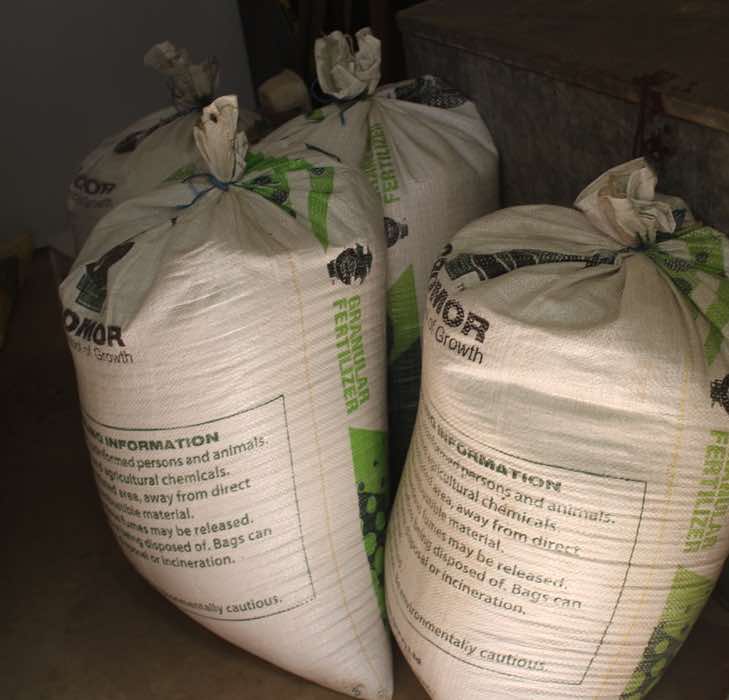 Direct from the farm, wheat is cheap.
And if there are a few weevils ground up in your flour, they add a bit of protein and are certainly less troublesome than the unseen poisons. What the eye does not see, your family won't whinge about.
This week I have opened a bucket of 3-year old frozen wheat; no sign of weevils whatsoever.
But it adds another expense dimension. We get around that by using the energy from Mr Golden Sun to power our solar generator. That freezer runs mainly during the day when electricity is free. It is about a whole alternative lifestyle that we greenies are espousing.
Spend time, energy and money on abundant living; or a great deal more on doctors and medicines. Take your pick.
So healthy flour comes at a price. Once your systems are in place, it doesn't take a great deal of time. Every morning I take wholewheat kernels from the airtight bucket, grind them in our Hawo which takes perhaps one or two minutes and then proceed with baking our low GI bread as usual.
Cookies and cakes
Nearly 50% of those eating typical grocery store food are prediabetic; and may likely progress to the full-blown disease. I know because I was one of them.
There is currently a call to name prediabetes as Stage One of T2D; action taken timeously will then prevent the inevitable progression of the condition.
Cookies, cakes and commercial bread had to go for ever; then my HbA1c returned to a perfectly normal 5.4%.
You could use wholewheat for your general baking; but recognise that it will not produce cookies with the same consistency as using cake-flour.
Frankly they are junk-food and if you want to stay off medication and out of the clutches of doctors, then reserve such for high and holy days only.
I am very conscious as a doctor of the madness that some develop in relation to nutrition; that's to be avoided at all costs. The occasional junk food does less harm to your body, in my opinion than orthorexia as it is called may do to the mind.
Beware if you find yourself becoming someone who can only talk about what you can't and will not consume. If you refuse to eat out because the cook may have used margarine, MSG or hydrogenated oils for example, then trouble lies ahead.
The Hawo is beautifully made and, because it draws only 230 watts, it can be easily powered by solar energy; if you have the equipment to capture it. That electricity is free but collecting and storing sunshine and converting it into a usable form is not cheap.
About ten thousand dollars is what I paid out but then in a country with a reliable supply of electricity, you wouldn't need the batteries. They cost about one-fifth of the total.
Electric mills
There are alternatives to the Hawo without the beautiful wood; some may grind the wheat even more finely apparently and cost about half. I have not used the Mockmill 100 myself but I would consider it if I was you; and the Komo Mio.
The synergy of green living more than makes up for the cost
and schlep; life is simpler with less pain and loss of well-being.
Does flour go bad? Yes, it certainly does, and especially if the anti-oxidant vitamin E has been removed. I find it scandalous that the food industry can by international law label it as such after 40% of the goodies have been extracted for animal feed.
Learn more about how to preserve your wheat berries from bugs, heat and moisture.
Healthy flour
What is the healthiest type of flour and should we buy a mill?
Healthy flour is a perishable product because of the sensitive nature
of substances like vitamin E and omega 3; it certainly has a limited
shelf-life.
If you bake daily, you will pay off the cost of this top of the range Hawo in less than two years; mine is still going strong after 25 years, with never a hiccough.
You could purchase a cheaper electric flour mill. The only one I do not recommend is hand-driven; it will not get the flour fine enough. I used such for several years whilst an indigent chiropractic student in Chicago.
There is a widespread practice in growing wheat to spray it with glyphosate, a known cancer-causing herbicide, just before harvesting. When you purchase a supermarket loaf of bread, or cake flour, you have no idea whether it contains residues of this nasty chemical.
Purchasing your own grain for grinding, knowing the source, empowers you. Large conglomerates like Monsanto and Bayer don't give a damn if you die from a malignancy; only the bottom line concerns them.
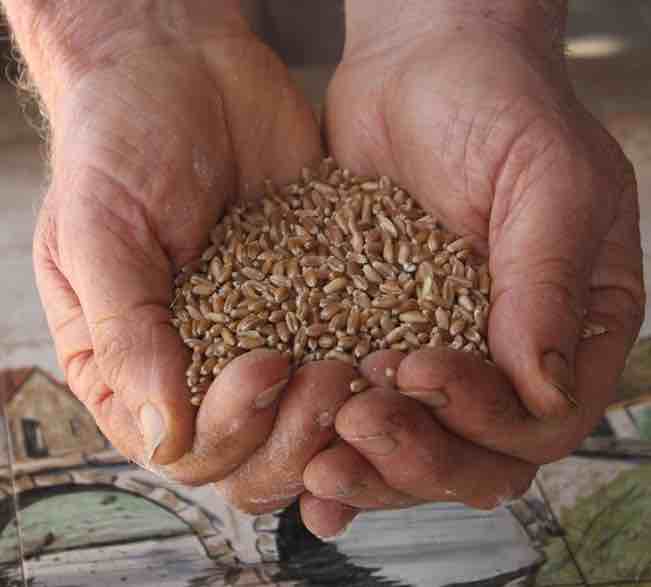
Vitamin E in true wholewheat flour
The vitamin E in healthy flour is chiefly the alpha isomer; why is that important and what is gamma tocopherol?
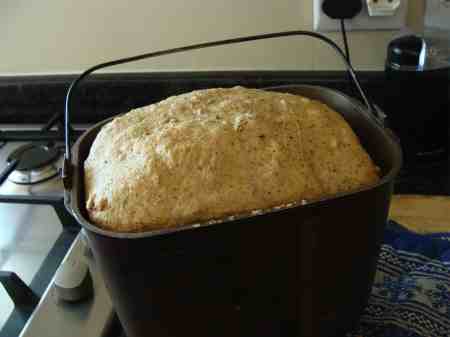
Start with wheat from the freezer; slightly more perhaps than you expect to use. I sometimes put it through twice, so you'll see the remains of some flour on the sides.
Fresh wholewheat flour is particularly rich in vitamin E but don't expect to find any if it has been on the shelf in the supermarket for more than a week.
Do you know the signs and symptoms of an impending heart attack?
Incidentally and this is important, do not buy vitamin E capsules that have only alpha tocopherol; it increases the risk of prostate cancer by competitively inhibiting the absorption of the gamma isomer that gives protection against malignant tumours down yonder.
Healthy flour is one of the main sources of another vitamin, B1 called thiamine; mild shortages produce fatigue and chronic heart failure but severe deficiencies cause generalised muscle weakness and a serious, fatal neurodegenerative disease.
It takes no time at all to grind the wheat for our low GI bread. When it reaches the top pink mark, turn the grinder off. The black marks are for a half loaf. Healthy flour and water levels respectively.
Healthy flour is rich in wheat germ and bran.
You'll find better solutions at quick constipation relief with none of the side effects of too much bran.
Phytosterols and Lignans
What are phytosterols and which are to be found in healthy flour you may be asking? Also there are the lignans in the bran. If you like tahini you'll know about them too; another rich source.
Five hours later you have the most delicious healthy bread made entirely without the tricks the baking industry uses to put a loaf on your table.
What's more it comes in at less than half the price of low GI bread from the supermarket; bake it yourself.
I have alluded several times to the fact that healthy flour is particularly rich in phytosterols. More, the refined product has none.
In short they are plant fats with a structure very similar to animal cholesterol; they compete for absorption, reducing the bad fraction of blood fats.
Tabbouleh bulgar wheat is a Lebanese dish particularly rich in phytosterols.
Research shows it's better to get your smart bran from 100 percent wholemeal than as a refined and then enriched cereal.
SUMMARY OF PHYTOSTEROLS
- They have a structure similar to animal cholesterol
- They compete with consumed cholesterol-rich foods for absorption
- They reduce the bad fraction of blood fats
- They are located in the germ and bran of grains
Ferulic acid in the bran
Ferulic acid is one of the so-called phenol plant nutrients known to be so beneficial to our well being. It is found the bran of wheat and oats; and the pectin of apples, for example.
It is also in the hull of flaxseeds, one of our much favoured products, more famously known for its high omega-3 content.
It's an essential component of the lignans in the bran.
Ferulic acid is given the credit for the ability of whole grains to lower cholesterol and hypertension; and stabilise raised blood sugar.
Alas most of it is removed in the refining process of grains and instead fed to the pigs; humans are left with the least valuable part of wheat and oats, that which makes us fat and likely to succumb to type-2 diabetes.
Your healthy flour is a rich source of ferulic acid. There's little proven benefit from taking it in supplements. Let your food be your medicine.
Eat only true whole-grain flour; and don't be deceived by the millers.
SUMMARY OF FERULIC ACID
- Located in the bran
- Lowers blood cholesterol and hypertension
- Stabilises blood glucose.
The fatty acids in healthy flour
Healthy oils in wheat
- Linoleic acid (ω-6)
- Palmitic acid
- Oleic acid
- Linolenic acid (ω-3)
Percentage
- 55%
- 16%
- 14%
- 7%
There are only two essential fats and both of them are found in the germ of healthy flour. We cannot enjoy optimal nutrition unless they are both consumed from our diet.
- Linoleic acid (an omega-6)
- Linolenic acids (an omega-3)
These two essential fatty acids interact in a very important way to promote and inhibit inflammation in the body; the balance between them is vital. The modern grocery-store diet is overloaded with omega-6.
If we do not get enough of the omega-3 in our diet it correlates with many of the inflammation-related diseases in the body[2].
Omega-3 in unrefined flour
The omega-3 linolenic acid in healthy flour is one of its vital constituents that is extracted by refining.
All these are healthy oils but a few things are noteworthy.
- The
ratio of the omega-6/3 is very mildly on the high side in wheat at 8 to 1. That
tends to be inflammatory in the body, especially if you ate a meal of
bread and most margarines; and use a typical salad dressing
made of one of the seed fats. Rather butter or olive oil on your sandwiches.
- Anti inflammatory omega-3 is one solution to chronic pain.
Did you know that butter is back?
- The oleic acid is particularly important as it forms the basis
of the myelin sheath that coats most of the nerves. Hence the importance
to me as a chiropractor and is one of the reasons I strongly recommend
healthy flour.
- The palmitic acid is relatively low at 16%.
It's a very common oil in plants and animals; we get plenty and
perhaps too much. It has been linked to raised cholesterol but this
remains controversial.
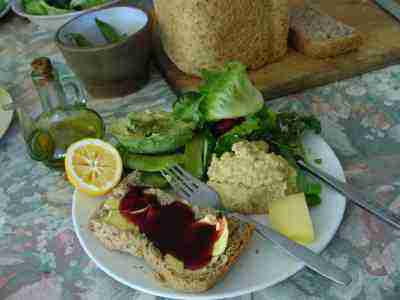
Let your food be your medicine
was the sound advice of the famous sage Hippocrates; he is given the
credit for being the founder of both allopathic care and chiropractic.
Now who on the planet had a more delicious and healthy lunch than the one I enjoyed today? All I could think to improve it would be a portion of smoked wild salmon.
Butter not margarine, note, in liberal amounts. It lowers the GI of your meal further and with so much phytosterol, you need have absolutely no fear.
You can enjoy your bread
and butter without angst.
Can you go overboard about this health food stuff? Yes, you certainly can.
If
you find you can talk about nothing else than the foods you cannot eat,
and you start refusing dinner-dates because the cooking might contain
this, or that, or the other, then you may be in danger of what I call health nut neurosis. It's a serious psychological malady known as
orthorexia, first cousin of anorexia.
Instead just enjoy more wholewheat bread, an apple a day and plenty of salads.
Just one apple a day reduces your risk of dying by a massive
41%, the Predimed study found. It is astonishing and so easy. Do it. We advocate eat food that is in season; starches that have been in cold-storage become highly glycaemic. In midsummer choose another fruit; ours would be cherry guavas.
Sourdough bread using true wholemeal flour
For millennia before commercial yeast was available in neat little packets, the leaven was made from a mixture of rye flour, raw honey and water. It's so easy to make yourself, feeding it periodically with more rye and honey; then you add it to your healthy flour.
This natural fermentation of the bread
dough is what helps break down the proline that causes gluten
intolerance in many; and the phytic acid in the bran that binds minerals
like iron and calcium. With Tired all the Time syndrome
becoming endemic in Western women, eating mineral rich foods but also
combining them correctly to enhance the absorption of those nutrients is
important.
You have to use unchlorinated water which would kill the yeast cells and lactobacilli. Harvesting the rain is the best choice of all.
Follow this sourdough bread recipe for more directions on making your loaf using a bread machine. It takes me less than ten minutes, including grinding your healthy flour, plus another five hours of course.
Bread experiments enable you to bake an even better loaf.
Are phytates bad is an important question.
Vegan seed bread
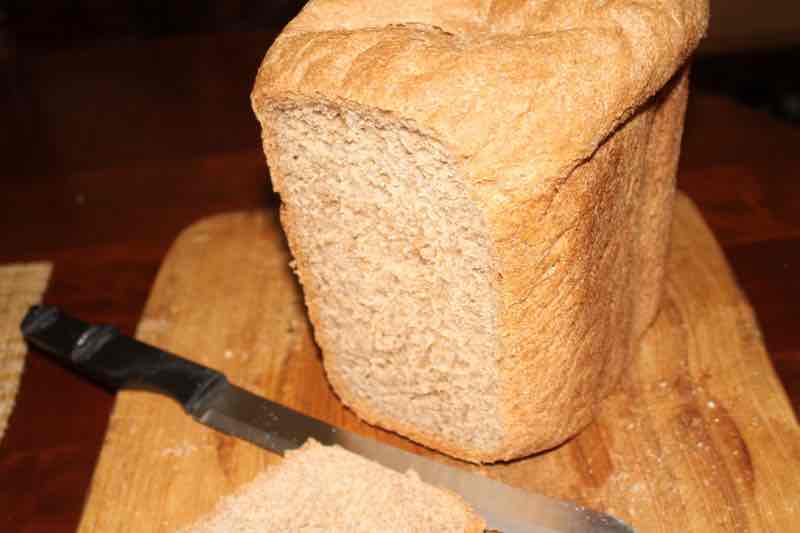
Bread is often fingered as a cause of obesity; that really only applies to the loaves bought in the supermarket from which much of the fibre, fats and vitamins have been removed.
Healthy flour is even less of a problem particularly if you follow this vegan seed bread recipe. The added fibre, protein and fatty acids lower the glycemic index even further.
Olive bread recipe
This olive bread recipe is made the old-fashioned way; when you've spoiled yourself with a slow day. Make a double; the family will be tucking in and it keeps.
Multiple Sclerosis
For reasons that remain unknown but is certainly linked to the huge surge in autoimmune diseases over the last fifty years, an abnormal immune response to a foreign substance in the diet causes inflammation that destroys the cells called oligodendrocytes; they produce myelin in the brain and cord.
Once that myelin is damaged, nerve conduction is slowed causing multiple sclerosis.
In short try to keep that ratio of omega 6 to 3 in your diet well below 10; in the typical American diet this ratio is often above 20, and even over 60 in some cases. It causes inflammation, affecting nerves, muscles and joints; and blood vessels that become red and angry.
The confusing thing is that linoleic acid is an essential omega-6 fat; we cannot live without it. But too much of even a good food is highly inflammatory.
Use
olive oil to reduce the omega 6 and eat fish and true wholewheat bread to increase the 3; whilst much of the research about MS is confusing and
contradictory, there's general agreement that less animal fat and more
from plants is beneficial if you are suffering from MS.
- Polyunsaturated fatty acids and their potential therapeutic role in multiple sclerosis[5].
Eat bread made from 100% whole wheat flour that is rich in oleic acid, a large part of myelin; it's high in olive oil too.
Having said that, healthy flour is not easy to get, unless you grind the wheat yourself.
Try as much as possible to stick to natural healthy meals and avoid fast foods. Apply your mind to getting your ten coloured fruits and vegetables per day.
Otherwise there is a great increase in the risk of tingling in arms, hands and feet; and you know what.
Strong hearts
Research in the Journal of Internal Medicine reveals that every extra serving (28g/day) of a true whole grain is associated with a 5% lower risk of overall mortality; and 9 percent lower risk of cardiovascular disease[1]. That's healthy hearts.
This has all been confirmed by researchers publishing about heart, stroke and diabetes, noting that nearly 50% of deaths and many more disabled people, were entirely avoidable.
The
reasons are complex but in other research reported in JAMA scientists revealed
that women eating 6 portions of whole grains every week had less
coronary artery calcification and stenosis. However the fibre alone
from fruit, veggies and refined grains had no benefit on slowing
cardiovascular disease.
Using your own healthy flour clearly
has enormous benefits; just as important the taste is simply wonderful,
particularly if you make the working man's loaf in your own kitchen. What is artisan bread, you are probably wondering.
Calcium in true wholemeal
With research showing that taking calcium tablets causes deposition in the intima of the coronary arteries and increased heart disease, it confirms that we must look to our food for nutrients.
New research
published in the medical journal Neurology reveals too that elderly
women taking calcium supplements have a higher risk of developing
Alzheimer's disease[2]. Even worse, if she has had a stroke or
has signs of cerebrovascular disease the odds are seven times greater; that is
massive. Are you taking pills for hypertension?
Whilst your healthy flour has only small amounts of calcium, it all contributes. 1 cup of Bulgar wheat, for example, contains 18mg of this important mineral.
It is tragic that all supermarket bread has added calcium; it should never have been extracted in the first place. That is one of the many causes of high blood pressure; bake your own.
"Nothing is less productive than to make more efficient what should not be done at all."
- Peter Druker
Choline and betaine
Choline is now recognised as one of the B complex vitamins; and betaine is its metabolite. They are intrinsically involved in methylating highly inflammatory homocysteine and turning it back into methionine.
Deficiencies of choline and betaine significantly raise the value of
three inflammatory markers; hence the influence of healthy flour on preventing heart
disease. It's a good source of these nutrients.
If you are suffering from the ravages of anticholinergic side effects then it's time to stop and consider; they are very dangerous medicines.
We mess with the choline in our bodies at our peril.
Choline food sources include eggs, liver and the green leafy vegetables in addition to 100% whole wheat.
Healthy flour in Hilton, South Africa
Whilst I am not excited about selling healthy 100% wholemeal flour, perhaps it's time to put my energy where my mouth is. In every town and village there needs to be a small-time miller who will grind flour daily and sell it that day.
If I can get a Mockmill 200 I will consider it, selling at Reko Hilton. Then you too can bake your own real bread.
Healthy flour in Canada
Whole wheat flour sold in Canada has had five per cent of the grain kernel extracted, including most of the germ and some of the bran.
In
Canada up to five per cent of the wheat kernel can be removed during
processing; that should require a name change from “wholewheat flour” but it hasn't been of course. The bran and much of the germ are removed to help reduce
rancidity and prolong the shelf life; and the bottom line for millers
It's hard to accept but we need to think of healthy flour as a perishable product; it needs to be freshly-ground or chilled like dairy products which creates huge problems for the industry. The only alternative is your own mill.
What is the healthiest type of flour?
What is the healthiest type of flour and should all bakers go out and buy a mill? You be the judge. On a personal note I consider it one of the most healthful decisions we ever made; in our upper seventies both the good wife and I have the blood pressure of teenagers.
from the journals
- Association Between Dietary Whole Grain Intake and Risk of Mortality
- Whole grain consumption and risk of cardiovascular disease, cancer, and all cause and cause specific mortality
- Essential fatty acid interactions
- Calcium Supplements Linked to Dementia Risk in Women
- Polyunsaturated fatty acids and their potential therapeutic role in multiple sclerosis
When browsing use right click and "Open Link in New Tab" or you may get a bad gateway signal.
Newsletter
Our newsletter is entitled "create a cyan zone" at your home, preserving both yourself and Mother Earth for future generations; and the family too, of course. We promise not to spam you with daily emails promoting various products. You may get an occasional nudge to buy one of my books.
Here are the back issues.
- Lifestyle and ideal body weight
- What are ultra-processed foods?
- Investing in long-term health
- Diseases from plastic exposure
- Intensive lifestyle management for obesity has limited value
- A world largely devoid of Parkinson's Disease
- The impact of friendly bacteria in the tum on the prevention of cancer
- There's a hole in the bucket
- Everyone is talking about weight loss drugs
- Pull the sweet tooth
- If you suffer from heartburn plant a susu
- Refined maize meal and stunting
- Should agriculture and industry get priority for water and electricity?
- Nature is calling
- Mill your own flour
- Bake your own sourdough bread
- Microplastics from our water
- Alternative types of water storage
- Wear your clothes out
- Comfort foods
- Create a bee-friendly environment
- Go to bed slightly hungry
- Keep bees
- Blue zone folk are religious
- Reduce plastic waste
- Family is important
- What can go in compost?
- Grow broad beans for longevity
- Harvest and store sunshine
- Blue zone exercise
- Harvest and store your rainwater
- Create a cyan zone at your home
Did you find this page interesting? How about forwarding it to a friendly book or food junkie? Better still, a social media tick would help.
- Homepage
- Wheat bread
- Special plant nutrients in wheat
- What Is the Healthiest Type of Flour
Address:
56 Groenekloof Rd,
Hilton, KZN
South Africa
Website:
https://www.bernard-preston.com