- Homepage
- Wheat bread
- Why is whole grain better?
- Can You Get Wholegrain Wheat
Can you get wholegrain wheat?
Can you get wholegrain wheat? There's talk of a "big fat lie" in milling circles. We must admit that the modern loaf is awful; no wonder bread sales are dipping.
This subject of wholegrain wheat is so
important for bakers and doctors of every ilk; it's all about a
so-important nutrient called betaine that is located almost exclusively
in the bran. It's been extracted by millers from most flours used for
baking bread and sold to farmers for animal feed; it reduces adipose
tissues in the flesh.
Food companies are allowed to describe their product as wholewheat flour so long as it contains 60 percent of the grain; according to Tufts University, even worse, that figure is 51%.

 The "didukh" is a decoration celebrating wholewheat
So which 40% have they removed? Your guess is as good as mine but I think you can assume, to make it more palatable to our tongues, it includes the bran and germ; what modern man loves is pure, white, highly refined starch.
Without that betaine we are highly prone to liver disease.
I learnt this the hard way some twenty years ago. After I had purchased a grinder, a patient brought me a 70kg bag of whole grain. For a while everything was fine, but within a month or two the grain was inundated with tiny black beetles. What was interesting was they ate mostly the kernel; that is where the goodies are to be found.
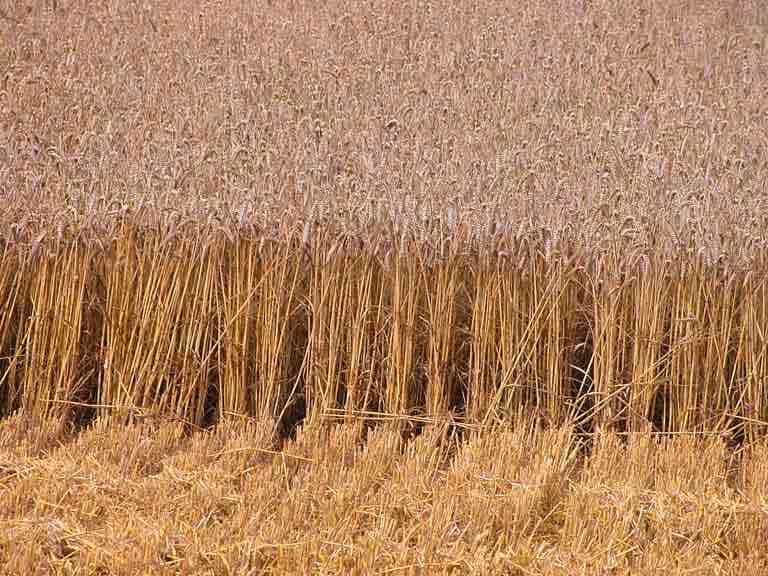
What's in a grain of wheat?
Food manufacturers make sure that we humans get mainly the starch; the bran and germ are extracted and reserved for animal feed.
The vitamins and fatty acids are found mainly in the germ. They are extracted and sold to us in capsules and the white flour appears on the supermarket shelves, bleached and devoid of all goodness. Is it any wonder that the Western world is so sickly and obese?
Note that brown flour is only white meal to which some of the bran has again been added. It contains little if any of the germ though this varies in different countries.
"A cereal is considered to be a true whole grain as long as all three original parts — the bran, germ and endosperm — are still present in the same proportions as when it was growing in the fields."
- Whole Grains Council[3]
So to be called wholewheat flour by law it must contain at least 60% of the original grain.
If you buy wholewheat flour grain and the beetles do not appear, it is because it has been poisoned with phostoxin. It kills the bugs but what does it do to us?
It has been said that, if you are going to build a house, purchase the best piece of land you can afford; likewise if you are going to bake bread, use only the finest ingredients. The real cost is your time, so why invest it in food cooked with ultraprocessed flour?
"Whole wheat flour in Canada may have up to 5% of the grain removed; most of the germ is often extracted to prevent the flour from going rancid."
- Whole Grains Council
The material expressed on this page is gleaned from the nutritional and environmental literature; it is clearly referenced. A plain distinction is made between the author's opinion and that which is scientifically proven. When in doubt consult your health professional.
To suggest a correction or clarification, write to Dr Bernard Preston here. Contact.
This page tells of the contradiction that flour
can be so labelled as wholegrain with only 60 percent of the goodies left. Nearly a
half has been extracted; the germ and the bran.
I eventually worked out a way around the problem. When the bag of
wheat arrives, it goes immediately into an old deep freeze that we keep
in the garage for two weeks. That kills the weevils and their eggs; it then can be stored indefinitely in air-tight containers at room temperature.
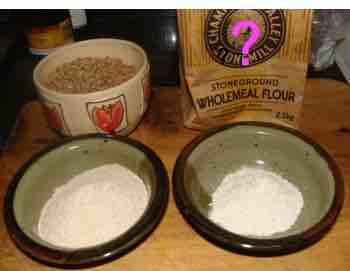
On the left in the photograph above you can see the wheat granules at the back and the flour after it has been through our grinder in the foreground; you will notice the pale brown colour.
On the right is "wholemeal "flour but you will
see it is quite a different colour, almost white. Nearly a half of the
wheat has been removed, quite legally, the germ and the bran
and the remainder is sold to us, masquerading as the real thing; but it
is not. It is a counterfeit.
Much of the goodness has been removed; that you can buy back from the health food store for a princely sum in capsules.
Part of the reason they do this is because the fatty acids start going rancid once the grain has been cracked allowing oxygen in. Refining increases the shelf life.
The other is that it increases their profits; the really valuable part is sold to the vitamin companies and for animal feed and they can charge more for wholemeal flour, except that it is not the real McCoy. Truth is that it is a big fat lie.
Is there a solution? Yes, there is but it comes at a price. Our electric flour mill is nearly twenty-five years old and never given a hiccough. Alas at 30 years it started troubling; the grinding stone came loose from the shaft.
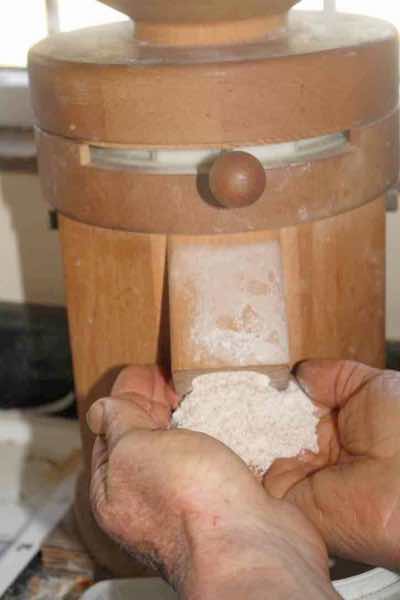
Our Hawo wheat grinder is ancient now and it's worked for all that time producing for us genuine stone ground 100 percent wholewheat flour; it takes about two minutes to grind enough for a loaf of bread.
Our flour from the electric mill, using wheat berries direct from the farmer, costs one quarter of the semi-refined stuff in the supermarket; 100% whole meal simply isn't available off the shelf in South Africa. You may be able to sniff it out in your neck of the woods; but remember, once ground the fats start to go rancid.
Whilst that is happening, I am busy preparing the rest of the ingredients. In all, it takes 6 minutes from beginning to end to make the bread dough, plus five hours of course for it to prove, rise and bake.
Your wheat grinder is not cheap, but it will pay for itself in about a year if you bake daily. In South Africa the whole grain cost R7 per kilogram in 2025, whereas the refined flour costs R30 from the supermarket. I expect the four times ratio is similar in your grocery stores.
Then you don't have to buy vitamin E capsules and the other goodies in genuine 100 percent wholemeal flour.
Best of all your own loaf, sans sugar, extra salt and preservatives tastes devastatingly delicious. It's a true health food, unlike that in your supermarket; unless it is sold as 100 percent wholewheat bread.
Whole wheat is the best source of the alpha-tocopherol fraction of vitamin E.
New research reveals that frailty syndrome is caused in large measure by a deficiency of four vitamins, one of which of course is E; more important, that from capsules it is far less effective. It is actually a family of 8 different compounds.
"Let thy food be thy medicine, and medicine be thy food."
Hippocrates (460 - 370 BC)
Vitamin E and oleic acid
100% wheat contains an abundance of vitamin E but you can be sure that your 60% "wholemeal" contains little or none. It is found in the oil fraction which has been extracted to prevent it going rancid. It's an important anti-oxidant.
The wheat germ contains a large amount of oleic acid, a monounsaturated fatty acid that is the main part of very healthy olive oil. This is particularly important to chiropractors as the myelin sheath that lines most nerves consists of this omega-9 lipid.
Without that fatty sheath nerves won't conduct. You may have heard of
"demyelinating" diseases that attack this lining; multiple sclerosis, for example.
One other fraction that is extracted in the milling of flour is the omega 3, alpha linolenic acid; shortened ALA. A diet rich in this plant nutrient is strongly anti-inflammatory in the body.
So you can see that whole wheat vs whole grain is a vitally important subject, especially since the millers are allowed to deceive us with their "whole wheat".
If you do purchase milled whole wheat flour, or even if you grind it yourself, do keep it in the deep freeze. It does not keep.
Lignans are located in the bran
Lignans are vitally important phytochemicals found in whole grain, but have usually been refined out in so called "whole wheat" flour. They are found in many other unprocessed foods too; legumes for example. It's a huge subject on its own and a major cause of the raised cholesterol that so many suffer from.
If you want to get off statins safely, then a large part of the solution is to start enjoying 100% whole grain bread; if you can find it. That's why we bake our own low GI loaf.
One helping of whole grain per day reduces the likelihood of prostate and breast cancer by nearly 50%; that protection is attributed to the lignans located in the bran.
Betaine: Less inflammation
Folk who's diets provided large amounts of betaine, which is rich in 100% wholewheat, have very significantly lower levels of inflammation markers like C-reactive protein. This is because it supplies a vitally important enzyme for the methylation of toxic homocysteine.
Virtually all the betaine is to be found in the bran and the outermost layer of the inner starch known as aleurone.
Researchers publishing in J Agric Food Chem have found that white refined flour contains almost no betaine as the aleurone layer is removed along with the bran in conventional milling[2].
True 100% whole grain is a rich source of this betaine, whereas the suspect, deceptively-labelled flour contains virtually none. Millers have spun such a network of lies around these terms that none of us can be really sure what's going on in the zoo.
Look for the term 100%; then you can be sure. We have chosen to mill our own wheat so we know it's rich in the anti-inflammatory betaine.
Spinach, beets and 100% whole wheat are the primary sources of betaine; any form of refining that extracts the bran removes this invaluable vitamin-like substance.
Because betaine is a metabolite of choline, it's not given vitamin status or considered an essential nutrient.
Healthy living tips
Healthy living tips are only for those ready to ring in some changes, and that's for you, because you wouldn't be reading about boring whole wheat vs whole grain flour unless you were already to committed to a new and alternate lifestyle.
It's little baby steps, one after another, that eventually leads to a whole new outlook on life. There's no better place to start than to declare that you will never buy white bread again. Don't become a healthy nut neurotic, so enjoy a soft roll when you go out to dinner with friends; just don't provide them in your own home.
Dietary fibre and lung tumours
Fascinating research shows that those who enjoy yoghurt and a high fibre intake have a 33% lower risk of getting lung tumours, even if they were smokers[1]. That is massive. Real wholewheat with all the bran has benefits far beyond issues around vitamin E and betaine. I assume that kefir would have the same or even better results.
Life without medication
Chiropractic help is not only concerned that your joints are moving freely; it's also interested in the state of the hyaline cartilage that lines them. That means a focus on our healthy living tips, the food we eat, and the exercise we should be having. All have a profound influence on your joints. Whole wheat vs whole grain is just one tiny part of being determined to enjoy better health; and live a life without medication.
Did you know that degenerative changes begins in the cartilage in a joint within thirteen hours, in white mice, if researchers immobilise the joint?
But even good joint mobility is completely inadequate if the synovial fluid doesn't contain enough oxygen and nutrients; enter whole wheat vs whole grain.
Without vital betaine found in 100% whole wheat, there is far more inflammation in the body; hence our interest at chiropractic help.
Can you get wholegrain wheat?
Can you get wholegrain wheat? It's so difficult to buy real flour.
From the journals
When browsing use right click and "Open Link in New Tab" or you may get a bad gateway signal.
Newsletter
Our newsletter is entitled "create a cyan zone" at your home, preserving both yourself and Mother Earth for future generations; and the family too, of course. We promise not to spam you with daily emails promoting various products. You may get an occasional nudge to buy one of my books.
Here are the back issues.
- Lifestyle and ideal body weight
- What are ultra-processed foods?
- Investing in long-term health
- Diseases from plastic exposure
- Intensive lifestyle management for obesity has limited value
- A world largely devoid of Parkinson's Disease
- The impact of friendly bacteria in the tum on the prevention of cancer
- There's a hole in the bucket
- Everyone is talking about weight loss drugs
- Pull the sweet tooth
- If you suffer from heartburn plant a susu
- Refined maize meal and stunting
- Should agriculture and industry get priority for water and electricity?
- Nature is calling
- Mill your own flour
- Bake your own sourdough bread
- Microplastics from our water
- Alternative types of water storage
- Wear your clothes out
- Comfort foods
- Create a bee-friendly environment
- Go to bed slightly hungry
- Keep bees
- Blue zone folk are religious
- Reduce plastic waste
- Family is important
- What can go in compost?
- Grow broad beans for longevity
- Harvest and store sunshine
- Blue zone exercise
- Harvest and store your rainwater
- Create a cyan zone at your home
Did you find this page interesting? How about forwarding it to a friendly book or food junkie? Better still, a social media tick would help.
- Homepage
- Wheat bread
- Why is whole grain better?
- Can You Get Wholegrain Wheat
Address:
56 Groenekloof Rd,
Hilton, KZN
South Africa
Website:
https://www.bernard-preston.com