- Homepage
- Eco-friendly homes
- Our Green Home
- Our green kitchen
- Homemade Hummus With Lemon Pulp
- Sesame Oil Benefits
Sesame oil benefits
Sesame oil benefits include excellent monounsaturated essential fats like linolenic acid; an omega-3.
As always we think rather of whole foods rather than pure, refined oils which tend to go rancid and acquire an unpleasant flavour. However, it is rich in anti-oxidants and thus more stable than other extracted vegetable fatty acids. Nevertheless, once opened it should be kept in a cool, dark cupboard or better still in the fridge; and the bottle finished with a week or two.
But what is in this foodstuff and what are its benefits? Is it something that should be high on your agenda?
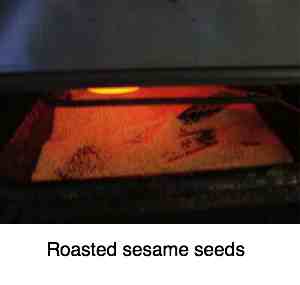

It is probably just personal preference but most people, myself included prefer roasted sesame seeds.
It is very simple; spread the raw seeds on a baking tray and place them under the grill until they take on a golden colour; and you can smell them. Stir them as they tend to burn, as you can see in the photo above.
You can then grind them in a simple coffee machine and blend them into sesame butter; with a bit of olive oil is my suggestion.
Sesame seeds are a good source of edible, nutritious plant protein but honestly, you would have to eat an awful lot to contribute significantly. Half is fat and a quarter is carbohydrate.
Sesame oil benefits
Sesame oil benefits add so much lovely flavour to your food.
Roasted sesame seeds
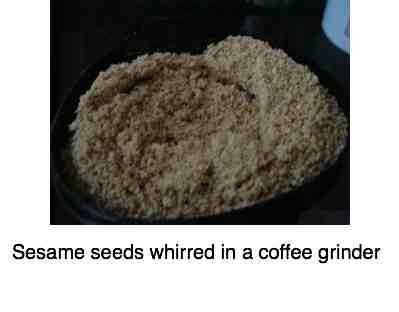
How to make Tahini; a sesame seed paste
How to make tahini is, to my mind only for those who do not have ready access to a Lebanese, Turkish or Greek shop. I made the paste from sesame seeds for our hummus for several years before discovering a company which imports large quantities from the Middle East. Many centuries of roasting sesame has outdone us.
Nevertheless if you are unable to find one of these little shops then making tahini should be on your agenda. It is particularly rich in calcium, the B vitamins and iron; all important for every woman in particular.
Best calcium for osteoporosis definitely should include tahini. Helen has it virtually every single day in her hummus; so do I.
Sesame seeds are particularly rich though not as elegant as flax but still excellent in phytochemicals called lignans that have vital anti-properties; they help prevent malignant disease particularly of the breast, slow oxidation and lower cholesterol.
100g of sesame paste contains:
- 17g of protein.
- 48g of fat.
- 26g of carbohydrate.
- All the B vitamins except B12.
- Vitamin K; do you bruise easily? Think also of parsley benefits.
- Large amounts of calcium, magnesium and iron; zinc too, all vital minerals.
Sesame Tahini recipes
Because of its delicious nutty flavour and nutritious benefits, tahini is used extensively in Mediterranean cooking, often in association with olive oil and honey.
An essential ingredient of homemade hummus with lemon pulp is this sesame paste.
Benefits of sesame oil
Sesame seeds are 48% fat, call it half of the seed. That oil is made up of these acids.
- 40mg of very nutritious monounsaturated fat, mainly the oleic acid that coats every nerve.
- 42mg of excellent omega-6 polyunsaturated fat.
- 8g of saturated palmitic acid; controversial.
Oleic acid is not one of the long chain fats that must be carried in the VLDLs that are associated with heart disease.
Omega-6 PUFAs (polyunsaturated fatty acids)
Sesame oil contains a large amount of linoleic acid, a PUFA. In itself, it is an essential fat. Your body is unable to manufacture it. So it is good; vital in fact.
So, why is there a but? Because the Western diet contains far too much PUFA. The result is that the ratio of omega 6 to 3 is also very high; and that means inflammation.
That ratio should be between 3 to 1 and perhaps 10 to 1. But the average Western diet is 20 and even up 60 to 1; inflammation, pain and stiffness. And because the lining of the arteries becomes angry, heart disease too.
Inflammation of arteries, muscles and joints is the result; and almost certainly the other organs like the colon. Too many PUFAs in the diet may well be part of the underlying problem with diseases like Ulcerative Colitis.
Palmitic acid is controversial. The official American Heart Association stand is that it is a saturated fat, a small amount only at 7% but to be avoided.
Let's compare olive and sesame oil benefits.
|
Olive oil Palmitic (saturated) 7-20% Oleic acid (MUFA) 55-83% Omega-6 Linoleic (PUFA) 3-21% Omega-3 ALA trace |
Sesame oil Palmitic acid 7% Oleic acid 35% Linoleic acid 35% Alpha Linolenic Acid trace |
In summary:
- Olive oil, the supreme queen, has even more palmitic acid than sesame. We need not stress.
- The olive contains double the MUFA, hence its great virtue. But sesame oil benefits include large amounts of oleic acid.
- Olive oil contains half the essential but inflammatory PUFA, should you have too much in the diet. It's all about balance.
- Both olive and sesame oil are low in the very good omega-3 fatty acid known as ALA.
To lower the omega-6 to 3 ratio further get your ALA from flax seed nutrition benefits.
The material expressed on this page is gleaned from the nutritional and environmental literature; it is clearly referenced. A plain distinction is made between the author's opinion and that which is scientifically proven. When in doubt consult your health professional.
To suggest a correction or clarification, write to Dr Bernard Preston here. Contact.
In comparison corn, canola and soybean oil all contain more than 40% inflammatory PUFA; and sunflower too. We really should limit them, particularly if we are prone to painful muscles and joints. Cold-pressed would be better, if you can find it.
In short sesame oil benefits are great but not perfect if you eat huge amounts, which you are most unlikely to; it is not that readily available. It does not compare with an olive garden salad dressing so you should not use it for your greens.
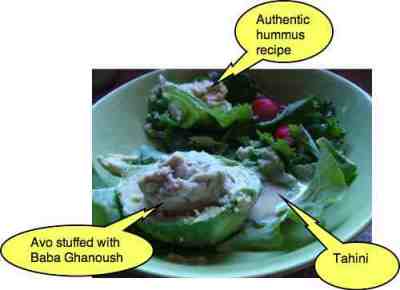
Most of our daily sesame oil is to be found in the tahini in our authentic hummus recipe; one tablespoon in a 500ml tub of our favourite salad dressing.
I do not advocate taking sesame oil; it is expensive and very readily oxidised when compared with tahini. It is also lacking in the lignans and and other phytonutrients so necessary for lowering cholesterol.
Rather make or enjoy shop-bought tahini; loaded with sesame oil benefits.
Authentic hummus recipe
Sesame is most often used not as an oil but in tahini to make hummus; it's the butter that is used so extensively in Mediterranean cooking. One of our favourites having been exposed to the Turkish community in the Netherlands is an eggplant condiment called Baba Ghanoush; excellent protection against high cholesterol.
Tahini on bread to mop up your salad dressing is another favourite; that is delicious.
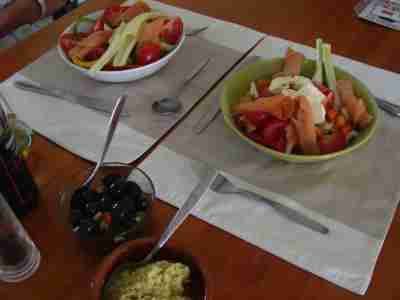
- Helen's fifteen euro salad saved my life, literally.
After a salad like that you can even have your butter and eat it.

Hypertension
Research reported in Yale J Biol Med. 2006 that 50
hypertensive patients were instructed to use sesame as their only edible oil
for six weeks. Their blood pressure dropped to normal whilst they kept on the diet.
But on withdrawing sesame seed oil for a further six weeks, their blood pressure returned to its previous hypertensive status.
Whilst using sesame seed oil, body mass index (BMI) was reduced, meaning they lost weight; as were serum triglycerides, whilst anti-oxidants such as vitamin C and E in the blood increased.
"The results suggested that sesame benefits, using it as an edible oil, lowered blood pressure, decreased lipid peroxidation and increased antioxidant status in hypertensive patients."
On a personal note, an anecdote and of no scientific worth, I enjoy sesame oil benefits every single day in tahini; I very rarely miss. This week I had some tests; despite being slightly overweight, nearly 72kg and love butter, cream and eggs, my blood pressure was 118/80 and total cholesterol absolutely normal.
Sesame seed oil extraction
Like all seed oils, extraction methods are vitally important. Read the labels when considering sesame oil benefits. If it looks beautifully clear, pale yellow, then there is a high chance it has been subjected to high temperature and solvent extraction. Move on to the next brand.
Generally the seed passes through a screw press which removes most of the oil; the remaining "cake" is then solvent extracted, refined with caustic soda and then bleached.
The tahini that I purchase cleared has added sesame seed oil; the label gives no indication how it was extracted.
Cold-pressed oils
Traditionally, sesame seed oil is extracted using cold pressed methods.
However modern, so called progressive industrial techniques to fulfill the consumer demands for a liquid that looks pure and clear uses high temperature solvent extraction, just like all the other commercial oils. The only exception is the olive which is still made using old fashioned cold-pressed principles.
Olive pomace oil however is also solvent extracted; although a lot cheaper, it's not to be recommended.
An obsession with purity
Here is an interesting aside. As a hobbyist beekeeper, I'm very aware that the honey industry faces a huge dilemma; is the consumer always right? Do you give them what they want, even if it is an inferior product?
"Pure" honey is inferior in every way; it must of necessity have been heated so that all the impurities including very important pollen granules and propolis could be removed.
Why do we have this fascination for purity? The best olive oil I ever tasted came straight from the vat after being cold pressed; thick and murky, it was divine. It is the same with my honey; not for a moment would I heat and filter it.
Interestingly I can charge more for raw honey. II would suggest it is the same for sesame seed oil and that from the olive; they are better and worth more.
I have tried making this recipe for sesame chicken; it is
just a variant of our delicious chicken barbecue, basting it with a herb and honey marinade. It is so easy.
In short start making sesame butter, it is so easy and then making your own tahini recipes like our authentic hummus recipe; that takes me only four minutes. You could too with a little practice.
Newsletter
Our newsletter is entitled "create a cyan zone" at your home, preserving both yourself and Mother Earth for future generations; and the family too, of course. We promise not to spam you with daily emails promoting various products. You may get an occasional nudge to buy one of my books.
Here are the back issues.
- Lifestyle and ideal body weight
- What are ultra-processed foods?
- Investing in long-term health
- Diseases from plastic exposure
- Intensive lifestyle management for obesity has limited value
- A world largely devoid of Parkinson's Disease
- The impact of friendly bacteria in the tum on the prevention of cancer
- There's a hole in the bucket
- Everyone is talking about weight loss drugs
- Pull the sweet tooth
- If you suffer from heartburn plant a susu
- Refined maize meal and stunting
- Should agriculture and industry get priority for water and electricity?
- Nature is calling
- Mill your own flour
- Bake your own sourdough bread
- Microplastics from our water
- Alternative types of water storage
- Wear your clothes out
- Comfort foods
- Create a bee-friendly environment
- Go to bed slightly hungry
- Keep bees
- Blue zone folk are religious
- Reduce plastic waste
- Family is important
- What can go in compost?
- Grow broad beans for longevity
- Harvest and store sunshine
- Blue zone exercise
- Harvest and store your rainwater
- Create a cyan zone at your home
Obese and terrified of fat-rich foods?
Don't be afraid of these sesame oil benefits. Without these essential lipids your brain which is 60% fat and nerves that are coated with a rich myelin sheath will die. Research now shows that it is simple sugars and refined carbohydrates like cakes, cookies and sweet donuts that are the villain of the peace; and white rice and sugary soft drinks too.
Interesting research proves that those enjoying fat-rich avocados are slimmer and have better waist lines and more importantly half the chance of getting metabolic syndrome.
Avocado, olive and sesame oil benefits abound; do not be afraid of these fats. It is the refined starches by and large that make us obese.
But obviously too much fat can be a problem too; well that is an opinion. Professor Tim Noakes thinks that unlimited animal fat, together with very low carbohydrate is the way to lose weight. Find these links using the Site Search function.
When browsing use right click and "Open Link in New Tab" or you may get a bad gateway signal.
- Homepage
- Eco-friendly homes
- Our Green Home
- Our green kitchen
- Homemade Hummus With Lemon Pulp
- Sesame Oil Benefits
Did you find this page interesting? How about forwarding it to a friendly book or food junkie? Better still, a social media tick would help.
- Homepage
- Eco-friendly homes
- Our Green Home
- Our green kitchen
- Homemade Hummus With Lemon Pulp
- Sesame Oil Benefits
Address:
56 Groenekloof Rd,
Hilton, KZN
South Africa
Website:
https://www.bernard-preston.com