- Homepage
- Eco-friendly homes
- Our Green Home
- Homemade probiotics
- How to Make Kefir
- How Do You Make Fermented Kefir Sour-cream
How do you make fermented kefir sour-cream?
How do you make fermented kefir sour-cream? First you will need the granules; they look like tiny cauliflower florets. You may be able to buy them but I would suggest you start by asking around your circle of friends and the local farmers' markets.
Needlessly because they are the latest "in-thing" the granules may be quite expensive; it shouldn't be so. Then the very simple next step is to make a fermented sour-cream.
There is no need to fuss over quantities.
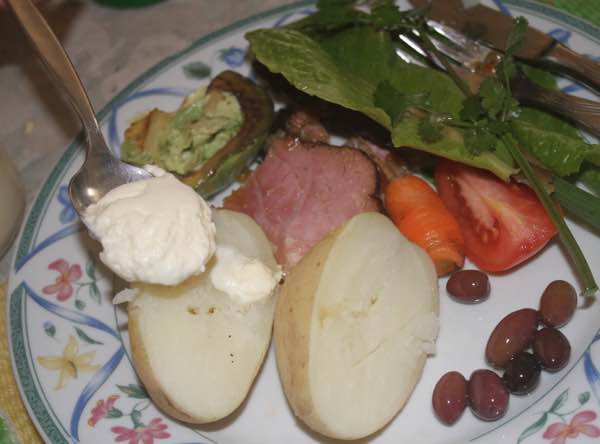
We favour only newly-lifted potatoes[2] that have more resistant starch than those from cold storage; they give a much lesser blood glucose spike.
And every day make certain that we have at least 7 different coloured foods; 33% lower all-cause of death from the many phytonutrients.

Ingredients
- 1 cup of cream, double-thick if you can get it.
- 1/4 cup whey from homemade milk kefir.
Go for it
- Pour the cream into a glass jar.
- Stir in the kefir.
- Loose-fitting lid.
You can start enjoying your fermented kefir sour-cream within a day or two. The longer you leave it the more tangy it will get. On a salad or baked potato I like it quite strong; not so in my grits.
It may separate into two layers after a couple days. That's not a problem; pour off the liquid if you want a thicker kefir sour-cream. Or just stir it back in.
Don't dispose of that yellowish liquid; drink it. It will be rich in nutrients and friendly bugs.
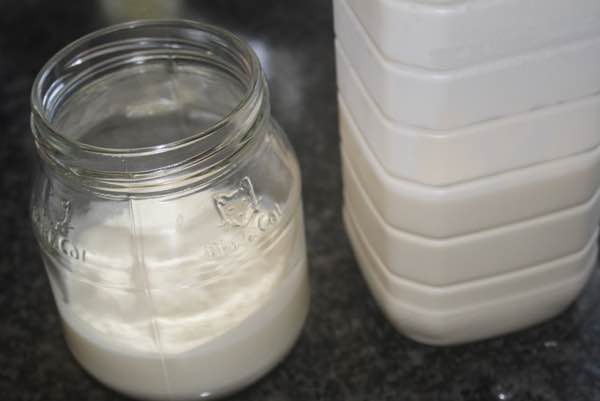 Double thick cream is best
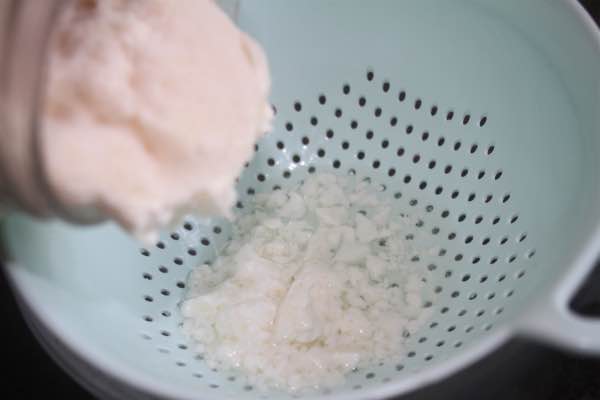 Strain off the whey
But is it safe?
Some mischievous person conned us into believing that like snakes and spiders the only good bacteria is a dead one; that's completely false.
And even snakes and spiders play an extremely important role in the ecology of the planet. We wipe them out at our peril; but do treat them with respect.
And likewise treat your kefir mother with respect. Keep your fingers and dirty spoons out and it will last indefinitely. Mine is nearly ten years old. If you find coloured spots appearing, then toss it and start again.
Friendly bacteria and the happy tum
Physiologists tell us that the happy tum has an astonishing 2kg of friendly bacteria, viruses and yeast cells; and some other strange creatures. But most of us don't come close to that.
Why is that? Firstly because of our unhealthy terror of these unknown but friendly creatures. So we have been encouraged from childhood to stomp on every spider, snake and bacterium; and then wonder why there is a cloud of flies around, rats in the ceiling and pathogens overtaking our bodies.
The healthy gut has a swarming, very diverse mass of these friendly creatures known generally as the friendly flora; or microbiome if you want to be technical. When a pathogen puts his toe in, he is simply outnumbered and doesn't have a chance.
But the reality is that because of antibiotics, chemicals in our food and the loss of the age-old tradition that includes homemade probiotics like kefir, kimchi and sauerkraut in our diet, most of us fall far short; and are sitting ducks when pathogens arrive.
"There are two main problems with modern food technology. Desirable substances are often extracted or destroyed; and harmful chemicals added."
- National University of Singapore
How tart do you like your kefir sour-cream
Once the cream is sour enough for you then you can put it in the fridge; that will slow the fermentation down.
How do you make fermented kefir sour-cream?
How do you make fermented kefir sour-cream? Is it safe?
I always say that just getting out of bed is dangerous. You might fall and break a hip or be exposed to someone coughing.
What is very unsafe is not to make homemade probiotics in your own kitchen. Researchers stress the importance of a broad spectrum of these friendly bugs and that you can't get from a pill. Commercially these foods like sauerkraut for example and so often preserved, boiled or sterilised. There are no living bacteria, only what is known as postbiotics; they too are important.
But first you have to learn how to make kefir; so easy.
Then try your hand at making this kefir salsa probiotic
Stomach and duodenal ulcers
There is interesting research that kefir will help overcome the bacterium causing stomach and duodenal ulcers[1]; possibly simply by flooding the gut with friendly bugs, the pathogens are displaced.
This is in fact where my own interest in probiotics began. Kefir fermented in our own kitchen sorted out 15 years of serious epigastric pain confirmed on gastroscopy to be caused by a Helicobacter infection and a small hiatus hernia; in one week. Medicines did nothing for the pain.
From the journals
When browsing use right click and "Open Link in New Tab" or you may get a bad gateway signal.
The material expressed on this page is gleaned from the nutritional and environmental literature; it is clearly referenced. A plain distinction is made between the author's opinion and that which is scientifically proven. When in doubt consult your health professional.
To suggest a correction or clarification, write to Dr Bernard Preston here. Contact.
Newsletter
Our newsletter is entitled "create a cyan zone" at your home, preserving both yourself and Mother Earth for future generations; and the family too, of course. We promise not to spam you with daily emails promoting various products. You may get an occasional nudge to buy one of my books.
Here are the back issues.
- Lifestyle and ideal body weight
- What are ultra-processed foods?
- Investing in long-term health
- Diseases from plastic exposure
- Intensive lifestyle management for obesity has limited value
- A world largely devoid of Parkinson's Disease
- The impact of friendly bacteria in the tum on the prevention of cancer
- There's a hole in the bucket
- Everyone is talking about weight loss drugs
- Pull the sweet tooth
- If you suffer from heartburn plant a susu
- Refined maize meal and stunting
- Should agriculture and industry get priority for water and electricity?
- Nature is calling
- Mill your own flour
- Bake your own sourdough bread
- Microplastics from our water
- Alternative types of water storage
- Wear your clothes out
- Comfort foods
- Create a bee-friendly environment
- Go to bed slightly hungry
- Keep bees
- Blue zone folk are religious
- Reduce plastic waste
- Family is important
- What can go in compost?
- Grow broad beans for longevity
- Harvest and store sunshine
- Blue zone exercise
- Harvest and store your rainwater
- Create a cyan zone at your home
Did you find this page interesting? How about forwarding it to a friendly book or food junkie? Better still, a social media tick would help.
- Homepage
- Eco-friendly homes
- Our Green Home
- Homemade probiotics
- How to Make Kefir
- How Do You Make Fermented Kefir Sour-cream
Address:
56 Groenekloof Rd,
Hilton, KZN
South Africa
Website:
https://www.bernard-preston.com