- Homepage
- Wheat bread
- Why is sourdough so important?
- Health Nut Neurosis
Health nut neurosis
Health nut neurosis warns us of the danger of literally going crazy about food.
There are three common responses to a sudden decline in wellness.
- I'm sick and want to be well, so I will make the changes that have to be made. That is the pragmatist speaking.
- Drat, I am sick but I just cannot make those changes to become fit again. The denialist is at work.
- I'm sick and there is nothing to be done. The depressive can be the most difficult.
There's a fourth, which is less common but very significant; the neurotic person.

This page was last updated by Bernard Preston on 26th May, 2026.
The neurotic faces the danger of exchanging a physical ailment, real or imagined and replacing it with a mental illness.
The illness is characterised by having no measurable parameters;
no one can gainsay it. I'm fatigued, sore or get dizzy if I eat this;
or do not have that vitamin or mineral pill. Then I get these
horrible cramps or some other symptom.
And of course there are many people suffering from these exact symptoms from very real conditions.
The key sign is usually a withdrawal from what we might call reality. I can't go to the restaurant or have supper with them because they might have used butter, old oils for deep frying or sugar; or tartrazine or something else. It is characterised by anti-social behaviour.
Health nut neurosis
Health nut neurosis describes how an over-riding passion about nutritious choice foods can lead to orthorexia nervosa.
Legitimate withdrawal
And of course there is a place for withdrawal for a variety of reasons, but it's for a season. I have hurt my back and I should not sit; I have got diarrhoea, or I am running a fever.
But always it's for a period and the sensible, legitimate withdrawal is characterized by a return to normal interaction with society, usually within days or weeks.
It is indeed a domain fraught with difficulties.
The health nut neurosis is all to do with degree. Is it okay to have a coke very occasionally? Can you enjoy a slice of very rich black-forest cake at a birthday party without feeling guilt?
Would you on occasion have a slice of white toast? I wouldn't; it is completely tasteless and boring.
I personally will not eat at a McDonald's restaurant. Am I neurotic? To a degree, perhaps yes; and I abhor margarine. Or, at least I do my level best to avoid it. I will break down, now and again and have french fries, even when I can smell the oil has not been changed for a week.
And where do we draw the line? I won't have a cigarette, a drink of hard liquor or soft drugs; not ever.
The chronically ill
But the chronically sick person has to engage their illness and make changes, uncomfortable though they may be. The type 2 denialist just ends up becoming disabled, dying or suffering unnecessarily from great pain.
Sometimes we feed off our illness though; oddly, it seems occasionally to fulfill a hidden need. The obese person, who knows they are in for great pain, perhaps a total knee replacement and huge cost but simply can't ring in the changes that are needed. It makes no sense.
Those changes might to some of us seem
simple enough. Stop smoking or die; is it easy? Certainly not. Start walking
daily or lose a foot from your diabetes. Eat foods rich in lutein or anticipate getting macular degeneration.
Start eating a salad and fruit or
suffer from the ravages of the subclinical malnutrition that is the
cause of a host of serious diseases; oh, that's far too much schlep.
Change without neurosis
At this site I have made a call to move steadily towards abundant living. Because if you're not going to look after the bod, where are you planning to live?
But let's do it without health nut neurosis. Go to fast foods restaurants now and then (that is the message for me), enjoy a white roll occasionally and have a beer periodically without guilt or apprehension; but steadily move towards the wellness living tips you read about here at this site. That is if you want to sit under the trees you once planted, and enjoy watching your grandchildren grow up.
Orthorexia nervosa
Orthorexia nervosa is the medical term for the health nut. It's an obsessive-compulsive disorder, alongside anorexia, but characterised by a fetish with eating cleanly.
Like all diseases, there's often a fine line between what is an illness and wholeness, especially in the early stages; take DM for example. An obese person has raised blood sugar, but not yet to the extent of being labelled diabetic. Tomorrow it could be quite different.
The material expressed on this page is gleaned from the nutritional and environmental literature; it is clearly referenced. A plain distinction is made between the author's opinion and that which is scientifically proven. When in doubt consult your health professional.
To suggest a correction or clarification, write to Dr Bernard Preston here. Contact.
So it is with orthorexia nervosa. Today you want to eat sensibly; that's good. But tomorrow you find yourself with an extreme preoccupation with avoiding foods perceived to be bad for you; that could be gluten, meat, or dairy. Or something else entirely that is your own particular aversion.
Provided that perception of good food remains correct, the illness remains in the domain of the mind. But sometimes the person's understanding of what is pure becomes twisted; then it can lead to malnutrition too because of an imbalance in amino acids, for example, or a deficiency of say vitamin B12.
Usually
it involves those foods that remain controversial. Are tea and coffee
bad? Are dairy foods only for babies? Which is the bad boy, margarine or
butter? Are starches like new potatoes and freshly-picked corn on the cob bad? What about gluten?
Often there's also an obsession with taking the many supplements on the market too. This makes such a person prey to doctors who peddle these products.
Key signs are:
- Do your dietary considerations make it difficult to eat out with family and friends, because there might be this or that in the food, or what they might say?
- Do you have feelings of guilt or even self-loathing if you indulge in one of your forbidden foods?
- Has the quality of your life suffered as a result of your new dietary restrictions?
- Have you lost a significant amount of weight? More than is clearly sensible. Is you BMI below 20?
- Do you spend more than three hours a day thinking about healthy food?
- Are you taking a bucket load of supplements?
Newsletter
Our newsletter is entitled "create a cyan zone" at your home, preserving both yourself and Mother Earth for future generations; and the family too, of course. We promise not to spam you with daily emails promoting various products. You may get an occasional nudge to buy one of my books.
Here are the back issues.
- Lifestyle and ideal body weight
- What are ultra-processed foods?
- Investing in long-term health
- Diseases from plastic exposure
- Intensive lifestyle management for obesity has limited value
- A world largely devoid of Parkinson's Disease
- The impact of friendly bacteria in the tum on the prevention of cancer
- There's a hole in the bucket
- Everyone is talking about weight loss drugs
- Pull the sweet tooth
- If you suffer from heartburn plant a susu
- Refined maize meal and stunting
- Should agriculture and industry get priority for water and electricity?
- Nature is calling
- Mill your own flour
- Bake your own sourdough bread
- Microplastics from our water
- Alternative types of water storage
- Wear your clothes out
- Comfort foods
- Create a bee-friendly environment
- Go to bed slightly hungry
- Keep bees
- Blue zone folk are religious
- Reduce plastic waste
- Family is important
- What can go in compost?
- Grow broad beans for longevity
- Harvest and store sunshine
- Blue zone exercise
- Harvest and store your rainwater
- Create a cyan zone at your home
Selling sickness
Health care in general feeds off the chronically ill; mostly it's with good intentions, but the greed factor prevails throughout and, when CEOs of big pharmaceutical companies open their mouths a little too wide, we the public know we always have to be on guard. They love the patient suffering from health nut neurosis.
Is there a doctor, or health food adviser, benefiting unduly from your diet? Is there someone selling sickness to you?
On a personal note
I myself will not drink colas, or eat white bread and margarine. I am reluctant to eat cookies and chocolate cake. Does that mean I am on the verge of orthorexia nervosa? Am I suffering from health nut neurosis? It's a fine line.
The only one of the six considerations above that might affect me is spending three hours a day thinking about food. Yesterday I spent five minutes baking our healthy low GI bread, two minutes squeezing the four citrus fruits drink, one hour planting leeks, and perhaps half an hour picking spinach for eggs Florentine, lettuce for lunch and broccoli for dinner.
Even that is less than three hours, though you might want to add the time spent enjoying these wonderful foods.
Be your own judge, but do be on guard; there's no point becoming neurotic about what we eat but, unless we have concerns about the rubbish dished up by the food companies, we cannot possibly reach a sparkling, vital eighty with all our marbles intact.
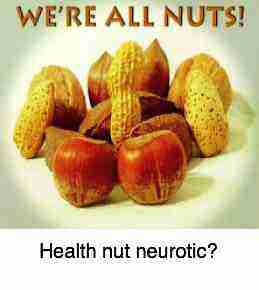
Speaking of nuts
Nuts should certainly be up there in your list of important foods; for example there is strong research of the correlation between walnuts and blood pressure.
Gluten intolerance
Gluten intolerance is another issue that can lead us to the edge of neurosis; and it's complicated because a very small percentage of folk really do have an issue with the protein in bread.
But the gluten fad has so taken over people's imaginations that they now perceive that every little grumble in the belly is caused by exposure to wheat; 40% of Americans for example are trying to avoid flour but instead are turning to ultraprocessed foods to their great detriment.
It needs to be said very plainly that for less than 1% of people they have to accept a strict and lifelong gluten-free diet but for the rest something else is almost certainly the cause of their abdominal pain.
Choosing ultraprocessed carbs over wholegrain wheat puts one at great risk of constipation, many forms of cancer and cardiovascular disease. A diet deficient in fibre, lignans and vitamin E is a disaster waiting to happen.
Food noise
Food Noise is a destructive part of the health nut neurosis syndrome; it's the persistent intrusive thoughts about our next meal, even whilst we are still eating the previous one.
The transition from healthy food to ultra-processed meals with all the associated pitfalls has caused many people to become truly anxious about what they are going to eat next.
"There is a little voice in my brain constantly reminding me about food and worrying about what I'm going to eat next," said one person.
In part at least it's because of the influence that the modern "industrial diet" is having on our Second Brains; lack of fibre, hundreds of different artificial chemicals and a lack of regular natural probiotic foods is shifting the microbiome from the bugs that are friendly and giving opportunistic pathogens the chance to flourish.
The absence of the balanced and complete microbiome that should produce a large proportion of the happy hormones starts to make us disturbed and anxious.
There's no right and wrong place to start dealing with these disturbing intrusive food thoughts. However making a daily probiotic like kefir at home and slowly increasing the dietary fibre to the recommended 35 grams per day would not be a bad idea.
Bernard Preston
Bernard Preston is a semi-retired DC, author of six published books and passionate about tasty choice foods; and something of a solar guru to boot. He sometimes wonders if he himself is on the verge of suffering from health nut neurosis; such is his passion for green living.
From the journals
- Go to nutritious choice foods ...
- What is orthorexia?
When browsing use right click and "Open Link in New Tab" or you may get a bad gateway signal.
Did you find this page interesting? How about forwarding it to a friendly book or food junkie? Better still, a social media tick would help.
- Homepage
- Wheat bread
- Why is sourdough so important?
- Health Nut Neurosis
Address:
56 Groenekloof Rd,
Hilton, KZN
South Africa
Website:
https://www.bernard-preston.com