- Homepage
- Wheat bread
- Why is whole grain better?
- What Is the Cost of the Fibre in All-Bran
What is the cost of the fibre in All-Bran?
What is the cost of the fibre in All-Bran? Is it exorbitant?


Less than 5% of Americans are consuming the recommended dietary allowance of fibre and it's probably little different anywhere in the world today where people are getting most of their food from typical grocery stores. The RDA is about 35 grams per day.
Consequently the prevalence of serious bowel diseases is taking off, especially in younger people. So one could make a good case of what is the cost of the fibre in All-Bran is irrelevant; if it's palatable and people are enjoying it, then it is money well spent.
Quick guide
How much fibre do we need?
The amount of fibre needed varies somewhat according to age and sex; as a rule of thumb you can work on about 35 grams, slightly more for men and less for the ladies.
However this is only a guiding figure. We are all different and the real question is how much fibre do you need so that you can have an easy daily bowel movement?
Recommended is a stool that has the consistency of a long slippery snake, neither rabbit pellets on the one hand nor diarrhoea on the other[1].
How much fibre is there in one helping of All-Bran?
The manufacturers recommends 40 grams of All-Bran for a helping. They claim that it contains 9g of fibre, three quarters of which is of the insoluble type; more about that lower down on this page.
Fibre is a starch but it is not glycaemic; it is not broken down in the small intestine to form glucose. Rather it passes through to the colon where it acts as a nutrient for the friendly flora, also known as the microbiome.
20 grams of the carb in a helping of All-Bran is glycaemic and will be digested by enzyme action to form glucose. 5g of that is added sugar; about 1 tsp. Overall the GI is low; around 40.
So one helping of All-Bran contains about 25% of the RDA of fibre; some websites claim higher percentages which may be true for women.
What is the cost of a box of All-Bran?
In 2026 the price of a 1kg box of All-Bran varied from R75 to 100; working on the lower figure, a 40g helping would cost about 3 rand, providing 25% of the fibre you require for the day.
If you were to have four helpings, not recommended then you could say R12 of All-Bran flakes would supply your entire requirements for a single day; however there would be too little of the soluble fibre. So add some fruit to your cereal.
Ingredients of All-Bran cereal
The principal ingredient of All-Bran is according to Wikipedia, wheat flour not bran; and that synthetic vitamins and minerals are added to "compensate for nutrients naturally lost during milling."
For example industrial folic acid is added to compensate for the natural vitamin B9 that is extracted during the milling process.
Folate is the natural form of vitamin B9; it is extracted and sold for animal feed. We should all be demanding answers as to why food companies think the health of cattle, pigs and chickens is more important than ours.
A whole grain should consist of the bran, germ and endosperm in the same proportions as found in nature.
This study determined that choline and betaine are particularly rich in the germ and bran[1].
There are two kinds of milling. One can be considered entirely "natural;" there is no separation of the three parts of the whole grain. None of the nutrients like betaine, folate and thiamine are lost.
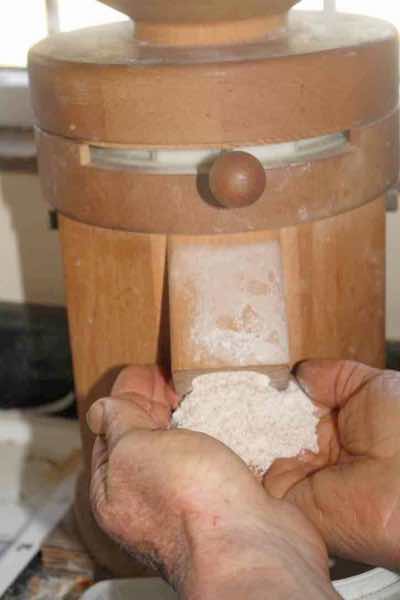
In the second kind of milling there is complete separation of the three parts; the endosperm, bran and germ. To make a "wholegrain flour" some but not all of the germ and bran may be added back.
Clearly many of the "natural" ingredients are extracted and lost. So this has to be compensated for; with synthetic vitamins and mineral formulations.
"The bran and germ are where you find most of the flavour in a grain of wheat. Removing them has the benefit of rendering the flour shelf-stable; but at the cost of most of its character."
How much fibre is there in a slice of true wholegrain bread?
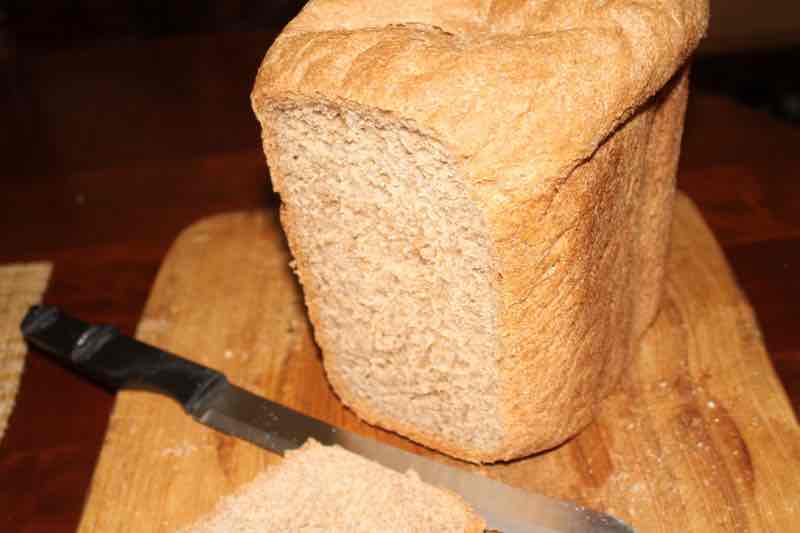 Each slice contain 5g of bran
Firstly let's acknowledge that it is almost impossible to purchase true wholewheat bread; it simply does not exist unless you have a mill and bake your own loaf as we do. But it makes an interesting exercise.
A loaf of our bread is made from 500g of flour, weighing about 1.2kg and yielding 16 slices.
1kg of wheat berries contains 160 grams of bran; so 1 slice would have 80/16 = 5g.
The price of a commercial sourdough true wholegrain loaf (if you can find it) is around R50; each slice costs about 3 rand.
So one helping of All-Bran flakes weighing 40g would contain 9g of fibre; a single slice of true wholegrain bread would have about half that amount. They would cost the same.
"Nothing is less productive than to make more efficient what should not be done at all."
- Peter Druker
Extraction of the germ, bran and goodness from wheat should be for cake flour only, retained for high and holy days. On a daily basis we recommend enjoying the umami of true wholegrain meal for our bread.
Having tasted true wholegrain sourdough bread only once, you will be very reluctant to return to the commercial loaf for your daily fare.
That is considered an extreme viewpoint by the majority; chronic poor health is the inevitable consequence.
Just the vitamin E which is nature's anticoagulant confirms the "extreme" viewpoint; it is unlikely there is any in All-Bran. Heart attacks and strokes are the inevitable consequence.
None of the natural vitamin E lost is "compensated" for in All-Bran; cardiovascular disease is the chief killer today.
If you have your own mill
If you have your own mill and make the effort to purchase the grain directly from the farmer at R8/kg, then your own sourdough loaf will cost you only 5 rand per loaf; 31 cents per slice containing 5g of fibrous bran.
Your bread would contain all the natural ingredients that give fresh flour so much flavour and of course all the unprocessed vitamins and minerals.
Is All-Bran an ultraprocessed food?
Whilst there is a move afoot to define our meals more precisely, currently All-Bran flakes is considered an ultraprocessed food according to the Jerusalem Post[2]; because of added sugar, industrial vitamins and minerals.
However your homemade loaf contains only wholegrain flour, the sourdough starter and a teaspoon of honey; these are all entirely natural products. Some bakers may add a little yeast.
By comparison, fibre in wholemeal grits
 3g of fibre in the grits alone costing 20c.
I will show you an even cheaper way. The cost of the fibre in true wholemeal grits is 20 cents (ZAR) for a generous bowl of porridge; for those with their own mill. It too contains about 3g of fibre.
"Dietary fibre is the remnant of the edible part of plants and analogous carbohydrates that are resistant to digestion and absorption in the human small intestine; but can be fully or partially fermented in the large intestine."
- Food Chemistry: X[3]
Soluble fibre
Soluble fibre feeds and supports the friendly flora in the gut, in particular the excellent Bifidobacterium species. It makes up about one quarter of that in wheat bran.
Soluble fibre such as beta-glucan absorbes water, swelling the stool and making it softer; it also produces more of the very important Short Chain Fatty Acids.
Insoluble fibre
Insoluble fibre on the other hands promotes a greater diversity of bugs in the gut. Both types are essential for normal intestinal health, roughly in a ratio of 1:1.
Wheat bran alone thus is lacking in the soluble components of fibre.
To support All-Bran as a tool to help alleviate constipation, it is recommended that more fruit and particularly dark green leafy vegetables are also consumed until a balance of around 15 to 20 grams of each is achieved.
What is the cost of the fibre in All-Bran?
What is the cost of the fibre in All-Bran? Are we being duped by another ultraprocessed food or is this good value for money?
SUMMARY
- All-Bran cereal is a reasonably good source of fibre at a fair price.
- All-Bran is an ultra-processed food made primarily from refined wheat.
- "Natural" nutrients extracted in milling are added back as synthetic compounds.
- One slice of true wholemeal bread contains half the fibre of All-Bran but all the "natural" nutrients remain untouched.
- The cost of the fibre in cornmeal for those with a mill is far less.
The material expressed on this page is gleaned from the nutritional and environmental literature; it is clearly referenced. A plain distinction is made between the author's opinion and that which is scientifically proven. When in doubt consult your health professional.
To suggest a correction or clarification, write to Dr Bernard Preston here. Contact.
From the journals
When browsing use right click and "Open Link in New Tab" or you may get a bad gateway signal.
Newsletter
Our newsletter is entitled "create a cyan zone" at your home, preserving both yourself and Mother Earth for future generations; and the family too, of course. We promise not to spam you with daily emails promoting various products. You may get an occasional nudge to buy one of my books.
Here are the back issues.
- Lifestyle and ideal body weight
- What are ultra-processed foods?
- Investing in long-term health
- Diseases from plastic exposure
- Intensive lifestyle management for obesity has limited value
- A world largely devoid of Parkinson's Disease
- The impact of friendly bacteria in the tum on the prevention of cancer
- There's a hole in the bucket
- Everyone is talking about weight loss drugs
- Pull the sweet tooth
- If you suffer from heartburn plant a susu
- Refined maize meal and stunting
- Should agriculture and industry get priority for water and electricity?
- Nature is calling
- Mill your own flour
- Bake your own sourdough bread
- Microplastics from our water
- Alternative types of water storage
- Wear your clothes out
- Comfort foods
- Create a bee-friendly environment
- Go to bed slightly hungry
- Keep bees
- Blue zone folk are religious
- Reduce plastic waste
- Family is important
- What can go in compost?
- Grow broad beans for longevity
- Harvest and store sunshine
- Blue zone exercise
- Harvest and store your rainwater
- Create a cyan zone at your home
Did you find this page interesting? How about forwarding it to a friendly book or food junkie? Better still, a social media tick would help.
- Homepage
- Wheat bread
- Why is whole grain better?
- What Is the Cost of the Fibre in All-Bran
Address:
56 Groenekloof Rd,
Hilton, KZN
South Africa
Website:
https://www.bernard-preston.com