- Bernard Preston homepage
- Cholesterol
- Tingling in Arms and Hands
Tingling in arms and hands
Tingling in arms and hands should not be ignored; and the legs too.
Paresthesias as they are known in both the limbs, the head and neck are distinct signs of a nervous system under stress. One should not jump to conclusions of rare diseases but they do occur; we will discuss some later. Think first rather of a few of the basics of abundant living.
Neurological sickness strikes fear into our hearts and not without good reason; images like the one below might flash through our minds. Is this in bad taste? Perhaps but for the first time there have been some real break throughs in the prevention and possible treatment of serious illnesses like motor neuron disease.
This page was last updated on 3rd January, 2024.
The first thought that should go through your mind, if you begin to experience tingling is one of adequate rest. Are you getting enough sleep? When did you last take a holiday? Have you been working too hard or watching too many thrillers on television; or spending long hours trolling the net?
The second thought concerns certain vitamins. They are intimately involved in the neurological system, preventing tingling in arms and
hands; legs and feet. Any deficiency will cause nerve degeneration.
One such condition is called pernicious anemia, caused by a shortage of
B12. Perhaps a supplement would be a good start. Jabs in the butt have been shown to
be beneficial. Eggs are the best source; vegans beware.
If you determine that you have anemia, consider adding both vitamin B supplements and iron-rich foods like beetroot and red meat to round out your diet.
Iron deficiency and anemia can lead to fatigue, irritability and other complications. Consult with your pharmacist to determine the appropriate dosages.
Of course first a diagnosis is important. Why are you anemic? Are you getting black stools or having very heavy periods? Are you regularly taking anti-inflammatory drugs?

"An unhurried sense of time is in itself a form of wealth."
Bonnie Friedman
Better still, look to your diet. The humble beetroot is the best natural vegetable source of iron; from dark-green leafy vegetables like broccoli and organ meats, iron would not be deficient in your diet unless you're into junk food.
Obviously a generalized vitamin deficiency means aspects of the diet are lacking. There is a rare condition is which B12 is not well absorbed, due to a deficiency of "intrinsic factor" secreted by the lining of the stomach; no matter how many tablets you consume but we will pass on that for the time being. See more lower down about pernicious anemia.
There are many important vitamins in the complex package. The only way to come close to sparkling great wellness is to eat a natural, rounded diet; and perhaps take a supplement tablet as well. I do periodically but it is not a substitute for choice foods.
Increasingly researchers are finding that vitamins and minerals from our food are far more effective than from tablets.
Whole grains of course, are the source of many of the vitamin B package. So, if you are only eating white rice, bread and cookies made from refined flour, then you can expect to be deficient.
But as we all know, true whole grains are not easy to find in on the supermarket shelves. Corn on the cob and unpolished rice are the two exceptions.
Fatty fish too are a rich source of vitamins, as is sunshine in moderate doses. Salmon, mackerel or pilchards should be on your menu in any case, twice a week at least, for their anti-inflammatory omega 3.
Notice the emphasis on sparkling good wellness coming from eating the right foods, not what vitamins, minerals and other pills that you are a swallowing. Nonetheless, there is a place for additional supplements periodically.
If a cluttered desk is a sign of a cluttered mind, then what are we to think of an empty desk?
Albert Einstein
For more information about foods that you should be consuming for the B vitamins, to prevent tingling in arms and hands, scout around at this site; there is oodles of information on pecans, genuine wholemeal flour and low GI bread for example. Do not forget the green leafy vegetables and freshly-squeezed citrus for the essential folate.
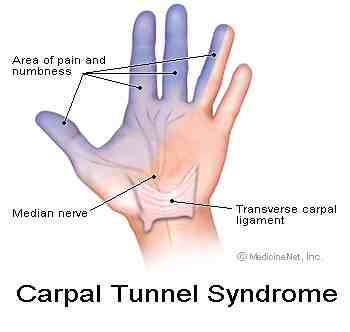
A third thought concerns an irritated nerve in your spine, or even after it emerges from your back. There are hundreds of possible causes but these three web pages will give you some idea of what I am talking about.
And now for a bit of science which will stretch you. Perhaps it is not your strong point but it is interesting. Stick with me if you are suffering from tingling in arms and hands; or legs and feet.
For information about possible causes of paresthesias, as they are called, follow the link below. A slipped disc in the neck often causes arm pain.
Tingling in arms and hands
Tingling in arms and hands, and the legs are irritating symptoms but once you have a diagnosis, you can live with them; it is weakness and pain that is far more serious.
This is a cross-section of your spinal cord. Ignore the little bits of details but see two parts of the cord.
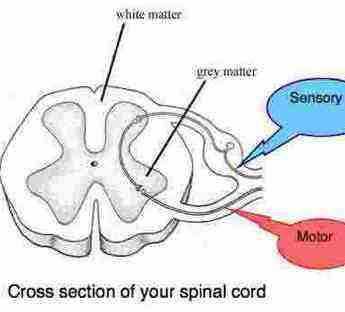
- The grey matter in the centre, in those funny shaped structures with horns. This is where the cell bodies of the nerves are. More about that later.
- The white matter outside of the horns. This is where the long tracts of nerves traveling up and down your spinal cord to and from the brain are found.
Also notice the motor nerve emerging at the bottom of the picture from the anterior motor horn in the grey matter on the way to muscles; and the sensory fibre returning higher up.
Damage to the motor nerve causes muscle weakness; to the posterior sensory nerve you might experience tingling in arms, hands or legs.
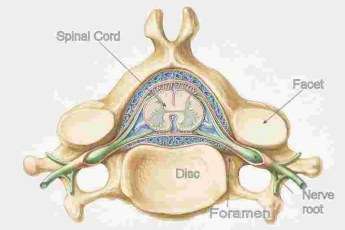
Below you can see how it looks in situ in the spine. Note the nerves coming in and out from the vertebrae, supplying the tissues of the body. They glide through a small gap in the spine called a foramen.
Again the one at the top, the sensory nerve brings information into the cord, and that at the bottom, the motor fibre, sends impulses out to the muscles and organs.
This is where the so-called Peripheral Nervous System begins. It is with this foramen where chiropractors work, nerves being irritated by either a facet joint injury, or a slipped disc; both are in close proximity to the mixed fibre in that little spinal gap.
The Central Nervous System, the brain and spinal cord are the most sensitive tissues in the body.
More regularly we see just tingling in arms, hands and legs but weakness occurs too if the motor nerve is injured.
Femoral nerve damage is more likely to occur in the older person, often affecting the front of the thigh and the quadriceps muscle; find more information lower down.
Guillain-Barre syndrome
If you live in a city of 100 000 people, then 1 or 2 persons will this year get Guillaine-Barre syndrome; about 5 000 total cases in the USA in a twelve month period. That is fairly rare I think you will agree, so do not start assuming that the tingling in your arms and hands that you are experiencing is caused by GBS. It is a quite rare neurological disease.
Guillain-Barré is an acute, rapidly-progressing, demyelinating disease and only affects the peripheral nerves. It will have lower motor neuron symptoms along with many sensory symptoms with possible autonomic dysfunction. It does not affect the upper motor neurons in the brain and spinal cord.
It is not known what causes GBS but it usually starts after a viral infection. Heavy sport while infected has been implicated. It can also be caused by vaccinations, still a very controversial subject in chiropractic circles, and has been reported after surgery.
According to the Centre for Disease Control (CDC): What happened in 1976 with GBS and the swine flu vaccine?
In 1976 there was a small increased risk of GBS following vaccination with an influenza vaccine made to protect against a swine flu virus. The increased risk was approximately 1 additional case of GBS per 100,000 people who got the swine flu vaccine. The Institute of Medicine (IOM) conducted a thorough scientific review of this issue in 2003 and concluded that people who received the 1976 swine influenza vaccine had an increased risk for developing GBS. Scientists have multiple theories on why this increased risk may have occurred, but the exact reason for this association remains unknown.
That means that the number of people who had the flu injection in that year nearly doubled the rate of GBS. A small risk? I have a cousin who developed GBS 5 days after a flu injection in 2010.
It is a devastating, life threatening illness, from which victims usually spontaneously recover. It strikes both the sensory and motor parts of these peripheral nerve roots, so the cardinal signs are sudden onset of tingling in arms and hands and legs, usually starting in the legs, and then quite profound weakness.
For the science boffins, this is a Lower Motor Neuron condition, so the reflexes are diminished, bilaterally.
Since it may affect breathing, it can be life-threatening.
For more detailed information about Guillain-Barré syndrome, read this fact sheet.1
Pernicious anaemia
Pernicious anaemia was a fatal disease until about a century ago, also causing tingling in arms and hands and lower limbs.
This is bizarre. The very smart doctor who worked this out, cured his patients by regurgitating his own digestive juices, and feeding it to his patients.
Pernicious Anaemia too causes tingling in arms and hands, but it is a whole different kettle of fish.
- Firstly, the cause is different, a vitamin B-12 deficiency. Whilst this can be a dietary deficiency, especially for vegans who eat absolutely no foods from animal sources, but more usually it is caused by repeated stomach disturbances leading to a chronic gastritis. For more about indigestion and heartburn use the site search button on your left.
Pernicious anaemia is also sometimes an autoimmune disease; they are flourishing in today's world; no one is absolutely certain why; there are most likely many causes, a poor diet of refined food high on the list.
- Secondly, it is a Central Nervous System disease; brain and spinal cord, remember? We will do a page on Alzheimer's later, so the reflexes are increased and there is spasticity and muscle spasms.
B12 works intimately with the mineral magnesium which is especially rich in recipes for Swiss chard. Together with folate and choline they are intimately involved in methylating toxic homocysteine, a natural breakdown product of protein metabolism.
Unless we consume these vitamins daily we will get seriously ill, and perhaps die. Remember pernicious anaemia was a terminal disease until the discovery of B12, and how it could be injected into the body. The richest source is the humble egg; eat them regularly; the heart association has completely removed the ban.

Free range, or pasture fed hens are difficult to find, and farmers cheat letting them out for five minutes and calling them cage free; do your homework, and be prepared to pay substantially more. They are certainly worth the extra.
Meantime, take the Alzheimer's Test. How many fff's do you see?
FINISHED FILES ARE THE RE
SULT OF YEARS OF SCIENTI
FIC STUDY COMBINED WITH
THE EXPERIENCE OF YEARS...
- Alzheimer's Heavy: You counted 3 fff's
- Alzheimer's Light: Not so bad, you saw 4 ffff's
- Senior Moment: You missed only one. 5 fffff's
- Genius: You got all 6 ffffff's. Well done. For some odd reason the brain has difficulty processing the word OF.
A bit more SCIENCE, I am afraid.
Tingling in arms and hand, legs and feet
We mentioned above the white matter in the spinal cord where the long bundles of nerves to and from the brain are found. Pernicious Anaemia affects two of them because Vitamin B-12 is essential for the building blocks of these nerves.
- One of the bundles affected is travelling UP the cord, carrying vital information TO the brain.
- The other travelling DOWN the cord FROM the brain.
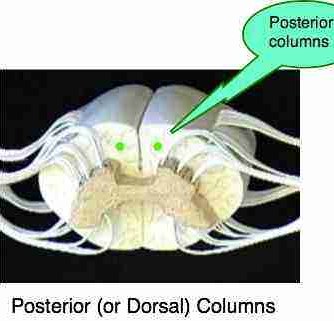
In the next picture, can you see those columns of white matter with the green dots? They are the so-called Posterior Columns that carry four very important nerve impulses to the brain, viz the ability to feel
- light touch
- knowing where your limbs are in space
- what is in your hand with your eyes closed
- vibration
All of this is lost in Pernicious Anaemia which is one of the reasons why the patient experiences tingling in arms and hands.
Pernicious Anaemia is particularly nasty because it also affects another bundle of nerves in the white matter, running in the opposite direction, down the cord. Can you see the Cortico-spinal tract in the next picture?
This is the long bundle of motor nerves coming down the cord from your brain (mine too! I'm using the CST right now to type) in order to give instructions to the muscles. Take note of it. If it's damaged it produces quite different signs - weakness. No tingling in arms and hands either because it is a bundle of motor nerves.
Actually, it's three different tracts. Makes no difference. Because they emerge from the Medullary Pyramids in the brain, a lesion of the cortico-spinal tract is called 'pyramidal'. Probably a bit of useless information for you so just forget it. Perhaps if you are a chiropractic student, remember that a pyramidal lesion causes spastic weakness.
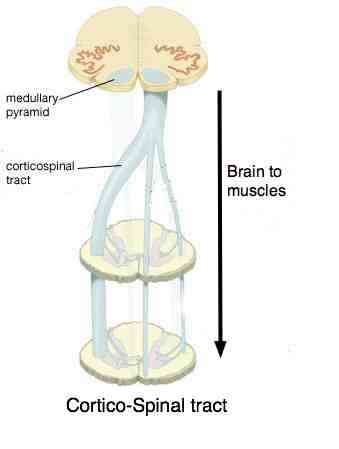
Can you see why a stroke (just one of many conditions that can affect the Cortico-spinal tract) produces weakness on the opposite side of the body?
Polio
Now, in the picture below, can you see the cell body of the motor neuron? (in the grey matter), and its Anterior Root (aka Ventral Root) going down to the muscle? This is what that bastard virus polio attacks. So the victim of polio would experience weakness rather than tingling in arms and hands and legs. But weakness of a quite different kind. When a cell body in Anterior Horn (in the grey matter) is attacked one gets a different sort of weakness, called flaccid paralysis.
Think of the difference between someone with a stroke (spastic paralysis) and another with polio or Guillain-Barre (flaccid paralysis). Quite different, eh?
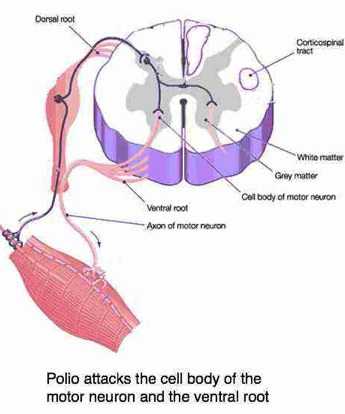
Polio is of course caused by a virus; enjoying a diet rich in vitamin C does help protect you against these nasty bugs. I enjoy freshly squeezed fruit from the citrus fruit list almost every day. Please note that OJ doesn't count; it's a highly processed junk food; press your own.
Amyotrophic lateral sclerosis (ALS)
Amyotrophic lateral sclerosis is a particularly nasty disease because, unlike Guillain-Barre it does not spontaneously resolve, nor like Pernicious Anaemia can it be cured and unlike Polio which strikes, leaves its mark and move on, ASL just progresses insidiously becoming chronic; compared to the acute onset of GBS and polio for example. Tingling in the arms and hands and lower limbs is less of a feature of this illness.
It is sometimes called Lou Gehrig's disease.
When the diagnosis is made, the patient finds their daily life torpedoed and their most fundamental expectations about life blown to smithereens.
It is not usually hereditary; it is in 10 percent of cases. Remembering that lifestyle and diet are inherited, is it in the genes at all?
If you live that city of 100 000 people, four will get amyotrophic lateral sclerosis this year. They will both die, usually within about three years, probably because they cannot breathe. The muscles just stop working.
ALS is particularly horrid because it not only attacks the cell body of the motor neuron (same as polio does causing weakness), but it also attacks the Corticospinal tract (upper motor neuron) that brings information from the brain to the ventral motor cell body; a double motor wammy.
The result is that ALS produces a bizarre mixture of signs. Weakness and wasting of muscles, muscle twitches and cramps, and increased reflexes. For the bofs, Upper Motor Neuron signs (because the Corticospinal Tract is damaged) and Lower Motor Neuron signs (because the cell body of the motor neuron is damaged). The end result - severe paralysis. Sensory signs and tingling are less common.
Please note that many of these signs occur in otherwise normal people. The twitching and cramping associated with ALS are the result of a dying muscle, therefore these symptoms without clinical weakness or atrophy of an affected muscle is likely not ALS.
Because you have cramps in a calf muscle does not mean you are about to get a severe neurological disease. That on its own is usually caused by a mineral deficiency, perhaps zinc or magnesium, or another.
ALS may start with weakness but not usually tingling in arms and hands, and clumsiness (such as in doing up a button) or in the legs, in which case victims begin to stumble; or in the face. Usually first it affects the voice and later swallowing; and finally the trunk muscles so breathing becomes difficult. This is the usual cause of death.
ALS is not generally considered an autoimmune disease. It is caused by defects and mutations in certain genes; the mutant protein then becomes toxic and attacking the motor neurons.
It is one of the reasons why this site strongly recommends a diet that is rich in antioxidants; they mop up the free radicals that damage our genes. It is almost certain that the lifestyle and food eaten in the United States gives it the highest prevalence of ALS in the world.
There are three factors that we strongly urge:
- Absolutely avoid all foods containing solvent extracted and hydrogenated fats; but do not shun the nutritious fats.
- Avoid high carbohydrate diets, and especially those starches with a high glycemic index.
- Enjoy foods rich in phytochemicals on a daily basis.
- In so far as we are able to return to unprocessed foods.
Newsletter
Our newsletter is entitled "create a cyan zone" at your home, preserving both yourself and Mother Earth for future generations; and your family too, of course. We promise not to spam you with daily emails promoting various products. You may get an occasional nudge to buy one of my books.
Here are the back issues.
- Investing in long-term health
- Diseases from plastic exposure
- Intensive lifestyle management for obesity has limited value
- A world largely devoid of Parkinson's Disease
- The impact of friendly bacteria in the tum on the prevention of cancer
- There's a hole in the bucket
- Everyone is talking about weight loss drugs
- Pull the sweet tooth
- If you suffer from heartburn plant a susu
- Refined maize meal and stunting
- Should agriculture and industry get priority for water and electricity?
- Nature is calling
- Mill your own flour
- Bake your own sourdough bread
- Microplastics from our water
- Alternative types of water storage
- Wear your clothes out
- Comfort foods
- Create a bee-friendly environment
- Go to bed slightly hungry
- Keep bees
- Blue zone folk are religious
- Reduce plastic waste
- Family is important
- What can go in compost?
- Grow broad beans for longevity
- Harvest and store sunshine
- Blue zone exercise
- Harvest and store your rainwater
- Create a cyan zone at your home
Lou Gehrig
Tingling in arms and hands is less of a feature of this motor neuron disease.
ALS first hit the headlines when a very famous American baseball player contracted the disease. It usually starts around 40-50 years old. If you have seen the film, you will not have forgotten how Lou whacked the bottom of a bottle of tomato sauce and splattered the whole table.
There is still no
known cure or cause for Lou Gehrig's disease(ALS). Is it like polio and
Guillain-Barre, a virus? Probably not. However, just recently, there
have been some extremely interesting developments into the causes of
ALS, and with what is known as a Ketogenic diet for a cure.
For more information about Lou Gehrig's disease follow this AlsA link.
Research
- Netherlands study.
- Japanese study
The diet of ALS patients before they became ill was compared with well controls, and the following results were reported:
"A diet high in poly-unsaturated fatty acids and vitamin E is associated with a 55 percent lower risk of developing ALS, and they appear to act together."
Again the diet of ALS patients before becoming ill was compared with a normal group, and researchers came to the conclusion:
"A diet high in carbohydrate and low in fat and some kinds of fatty acids may, when combined, increased the risk of ALS."
Incidentally, the Japanese are getting some very encouraging results from high doses of a form of vitamin B12 called Methylcobalamin injected daily intra-muscularly. In tablet form it's quite useless, insufficient is absorbed due to an intestinal deficiency of "intrinsic factor" perhaps one of the causes of ALS.
A bit of History
In the 1920's an American osteopath, Dr Conklin, postulated that epilepsy was caused by toxic chemicals in the brain, and put patients on long fasts of up to three weeks. Pretty extreme, I think you will agree, but the results were impressive, and despite his critics, considerable interest ensued.
This produces a state known as ketosis, in which the body is forced to derive energy from body protein and fat in the absence of any dietary calories. Exactly how this process helps epilepsy is still not known, and much research is currently being done.
Then the Mayo clinic started a treatment program, less severe than fasting, which produced similar effects with ketone bodies. The diet was very low in carbohydrate, with adequate protein for growth, and high in fat.
It too produced convincing results with epileptic children; it's not dissimilar to the Banting diet; find it here.
Interest then waned as anti-convulsive drugs started coming on to the market, and interest in Ketogenic diets lessened to the extent that it was almost non existent.
However, some clinics continued the use of the Ketogenic diet, one of which was the Johns Hopkins clinic. What really got the ball rolling was enormous interest generated by the successful treatment of Charlie Abrahams, son of a famous Hollywood producer, who despite medication suffered from uncontrollable seizures. Charlie's father then produced a film, First, Do No Harm , featuring Meryl Streep. Roughly 30% of children on the ketogenic diet had either no seizures, or they were 90% lessened. Most remain well controlled after returning to a 'normal' diet.
The rest is history. The surge in interest in the Ketogenic diet, not just for seizures but for all neurological diseases soared. And for weight loss.
My own belief is that the ketogenic diet in its many forms is definitely not for well people whose weight is normal. It means far too much animal protein in the diet, known to cause malignant tumours, and in any case we eat new potatoes and corn daily from the garden, on top of our easy sourdough bread recipe and have not put on any weight. It's the refined starches that are the devil and that is most food that comes in a box, and supermarket bread too.
How to grown corn is one of my passions. Remember though, that is in the context of a ten coloured foods per day overall meals.
Conclusions @ Tingling in arms and hands
Much of this confirms what we already know; a diet high in starches, particularly in high glycemic index carbohydrates like sugar and refined grains, is extremely toxic to the body.
Secondly, that the brain and nerves are made primarily of fat, and
that many of these diseases have to do with fat metabolism.
Interestingly, on this high fat Ketogenic diet, the children did not get
fat. In fact, they lost weight. The children of Europe and America are
not fat simply because they eat too much fat, but too much high GI starch and
sugar; bagels, french fries and the like.
A diet rich in 'good' fats is extremely beneficial to the
body. Where the research is now heading is whether long chain fatty
acids are better, or mono-unsaturated fats, or ... and what are the best
ratios, and sources, of these different oils. More fish oil? Or
Avocados? More Olive oil or Evening Primrose oil? Cold pressed Sunflower
...Salvia Hispanica? Time will tell. Meantime, if a loved one starts
with signs of a serious neurological disease, you know if which
direction to guide them. Even Parkinsons is showing promising results; broad beans also known as favas, are the only known source of L-dopa.
Hint: This salad (without the bread) would score high on the ketogenic diet. Perhaps add more Feta (or tuna) and plenty of olive oil.
- Worms for diseases of the Immune System. Are you serious, Bernard Preston? Deadly serious!
Butyrate
Butyrate is a short chain fatty acid produced in the colon by the microbiota fermenting resistant starch that has survived the journey through a very long and effective small intestine undigested. It has strongly anti-inflammatory effects and prevention of metastatic disease of the large bowel, but current research is finding that an effective gut, rich in many billions of beneficial bacteria producing butyrate is vital for preventing the neurodegenerative diseases that would also cause tingling in arms and hands, and legs, loss of memory and a Parkinsonian tremor.
Read more about resistant starch; one example would be the fibre known as pectin found in fruit.
Bernard Preston
Bernard Preston's lunch today consists of many organic green salads, avocado, feta cheese, hummus, and low GI bread and butter; occasionally there might be a slice of ham, or pilchards for example; the aim is to reduce the risk of getting serious demyelinating, or autoimmune neurological diseases causing weakness and tingling in arms and hands and legs.
The emphasis on greens is the presence of antioxidants that help prevent free radicals from attacking our genes. The fibre is one form of resistant starch.
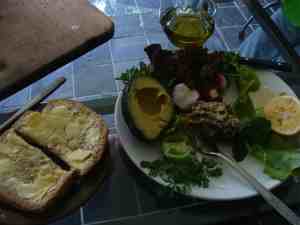
Olive oil or avocado, both fruits, should be enjoyed with your salad daily for their excellent monounsaturated oils. The oleic acid that coats your nerves is vital for normal condition; there's some in the butter too.
Think about an olive tree if you're in a winter rainfall region, or growing avocado trees in wet summer areas.
Nutritious choice foods
Nutritious choice foods reduce your chances of being struck down suddenly, and perhaps not so inexplicably, by these nasty diseases that cause weakness and tingling in arms and hands and legs; your diet has a huge part to play.
Let your food be your medicine, preferably before you get sick. Make space for nutritious choice foods in your diet if you dislike consulting doctors and chiropractors and abhor taking pills.
Strike Four Walk
Research costs money. Big money. The kind of research that cracks frontiers takes the best minds and highly sophisticated equipment.
We started this page with a depressing picture of a skeleton. I've pondered whether it was in poor taste. However, the reality of these nasty neurological disease is that people for no obvious reason, get sick and die.
On the hand, for the first time there is now hope for sufferers of diseases like ALS. And it's only because of top thinkers who are stretching their minds, hoping against hope that they will discover a way forwards to stretch out the lives of the sick.
Strike four walk is a team of walkers dedicated to support these researchers. Will you help them strike ALS out? This page is still under construction. More will be added about tingling in arms and hands and feet and face. And about paralysis.
These neurodegenerative diseases are not fun; yet I'm always impressed how one way or another they keep smiling; perhaps they have their very own just for laughs file.
Why all this on our website? Because patients walk into our clinics every complaining of tingling in some part of their body. Usually it is an irritated nerve, such as in Meralgia Paresthetica which is a double crush syndrome. A fibre is pinched in the lumbar spine and in the groin producing pain and/or numbness down the side of the leg.
But it could be a sciatica or pinched nerve in the neck causing tingling in the arms and hands.
In short, tingling in arms and hands, and legs is a very complex subject.
Use the Search Site function above to find the links to those topics highlighted in bold.
- Dizziness is also a different kind of tingling. DIZZY ...
Did you find this page interesting? How about forwarding it to a friend, or book and food junkie? Better still, a social mead tick would help.
- Bernard Preston homepage
- Cholesterol
- Tingling in Arms and Hands
Address:
56 Groenekloof Rd,
Hilton, KZN
South Africa
Website:
https://www.bernard-preston.com