- Bernard Preston homepage
- Citrus
- Lemon Drop Drink Recipe
Lemon Drop Drink Recipe
This lemon drop drink recipe is a refreshing way to enjoy more water, and get us away from sodas with all their chemical-additives and sugar.
Two fruits apparently have an alkalising-effect on the body, namely the lemon and the watermelon. It is probably difficult for you to grasp how a food, obviously acidic, can achieve this.
It has to do with the basic salts in some citrus; those of magnesium and calcium for example which are alkaline, so that the remaining ash after digestion is indeed not acidic as we would have expected.
This page was last updated by Bernard Preston on 4th July, 2021.
- 10 lemons
- 1/4 cup natural-honey, or sugar*
- 6 cups of cold unchlorinated-water
- Cut the ends off of two of the lemons, and scrub the skins thoroughly.
- Slice them thinly, setting one aside; remove any pips you see.
- Using a potato masher squish half the slices with the honey; whisk thoroughly. Set aside.
- Squeeze the other 8 lemons, not using a strainer; again remove any pips you see.
- In a large bowl, add the water and squeezed lemon-juice to the squished slices and honey, whisking it up.
- Add the thin slices of the last lemon.
- Refrigerate for an hour or two, allowing for the juices in the skin to be extracted.
- Bottle what remains but do not keep more than a few days in the fridge.
There is in fact absolutely no need to add either sugar or honey to this recipe. The above is equivalent to 12 tsp of sugar, approximating to a little over one teaspoon to a full glass of this concentrate; further dilution of say one to six means it is very low in any added sweetening.
One teaspoon of sugar or honey per six glasses of our lemon-drop drink won't do one any harm.
Choosing your lemons
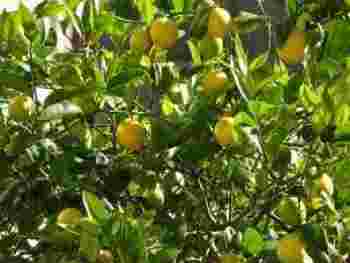
First choice always is to grow your own lemons and limes; the old adage is the first thing you do in a new-home is to plant one of each. Then you know they have not been waxed, sprayed and what the trees have been fed with.
Whether it's the scent from the flowers, a beautiful ornamental tree covered with bright-yellow fruit, or the nutrition of lemons and limes, they are always a winner.
But they do keep quite well because of the thick protective skin that keeps oxygen, the great enemy, out. Those with a very thick knobbly-skin may have less juice, but the quality is fine.
From the supermarket, assume they have been waxed to increase the shelf-life; scrub any when you are going to use the whole fruit very thoroughly in running-water. Much of the very valuable limonin is to be found in the lemon rind.
Lemon water
Without a doubt the best way to enjoy the fruit is to squeeze the juice of one lemon include the pulp into a large jug of water. Add a sprig of mint, ice and drink your lemon water; lots of it.
It is extremely refreshing and nutritious. I have just had a glass.
One chemistry teacher, asked about its acidic nature stated that lemon juice is essentially citric-acid and water. Well, sir, I have reason to disagree.
Lemon juice is of course largely water, at 93 percent; it is simply the solvent in which the carbohydrates, protein and fatty-acids are dissolved; the, vitamins and phytochemicals too.
And our lemon-drop drink recipe is in the main made by adding yet more water.
It is certainly a good deal more than citric-acid and water, but that quite likely approximates the lemon drop recipe used by soft drink companies; no doubt with plenty of added sugar or artificial sweeteners.
Carbohydrates
1. Natural sugars
After water a lemon is made up primarily of carbohydrates. In the juice, 70 percent of these are simple sugars, like glucose and fructose, but the pulp has a far higher concentration of complex polysaccarides; like the very resistant-starch called pectin.
It is not digested in the small intestine like those simple sugars, but passes right through to the colon where the very important microbiota feed on it.
Simple sugars are rapidly absorbed into the blood stream giving an insulin rush; they have a high glycemic index which is not good when taken in quantity, but fine in small amounts. In this lemon drop drink recipe you do not need to fuss, with so much extra water added; the amount of carbohydrate, simple or complex, is relatively low.
In contrast, whilst killing time on the winch at the gliderport recently, I was shocked to
discover that a two litre bottle of a common cola that someone had left
behind has a whole cup of sugar.
But when using a lemon in cooking, for example in making an authentic hummus recipe where the carbohydrate is not diluted, it makes sense to use the pulp and the juice, and not just the liquid, to increase the percentage of complex sugars. It is where the fibre is too, and it tastes better, so end of the story. Where possible use the whole fruit.
Do not ever buy hummus without reading the label by the way. Many brands are so full of chemicals and taste terrible.
One final thought on this subject of simple sugars in our lemon drop recipe. Astonishing research done on Germany has shown that the natural-honey from the beekeeper has little affect on the blood despite being mainly fructose and glucose. But once heated and refined by the bottlers it has a very high GI[4]. I bet the same is true of our unprocessed drink.
2. Acids
Then there are many different acids making up a small part of the carbohydrate. Compounds like the pectin that give your lemon-juice the capability of forming a gel.
This jellying power is what makes the lemon the housewife's choice in making marmalade. Then there are other organic substances like citric-acid.
3. Proteins
Your lemon juice also contains numerous enzymes (protein) which may act negatively on the pectin once the lemon is cut and exposed to air. Freshly-squeezed is what makes the difference. These compounds are very significant for our own digestive systems; they are what makes raw food so important.
Pectin gives your lemon juice it's "body". Once these enzymes start to break down the polysaccharides, it becomes first thicker and then all the "colloids" in solution will settle out at the bottom making it unattractive and the flavour deteriorates.
So to make your LEMON DROP DRINK RECIPE we will heat the juice to inactivate the enzymes. They do it also to all commercial citrus drinks. It does however lessen the value of your juice.
In addition your lemon juice contains almost all the amino-acids, only in small quantities. The exception is tryptophan and that is plentiful in egg, fish and soybeans; in dairy, sesame, and red meat too.
Newsletter
Our newsletter is entitled "create a cyan zone" at your home, preserving both yourself and Mother Earth for future generations; and your family too, of course. We promise not to spam you with daily emails promoting various products. You may get an occasional nudge to buy one of my books.
Here are the back issues.
- Investing in long-term health
- Diseases from plastic exposure
- Intensive lifestyle management for obesity has limited value
- A world largely devoid of Parkinson's Disease
- The impact of friendly bacteria in the tum on the prevention of cancer
- There's a hole in the bucket
- Everyone is talking about weight loss drugs
- Pull the sweet tooth
- If you suffer from heartburn plant a susu
- Refined maize meal and stunting
- Should agriculture and industry get priority for water and electricity?
- Nature is calling
- Mill your own flour
- Bake your own sourdough bread
- Microplastics from our water
- Alternative types of water storage
- Wear your clothes out
- Comfort foods
- Create a bee-friendly environment
- Go to bed slightly hungry
- Keep bees
- Blue zone folk are religious
- Reduce plastic waste
- Family is important
- What can go in compost?
- Grow broad beans for longevity
- Harvest and store sunshine
- Blue zone exercise
- Harvest and store your rainwater
- Create a cyan zone at your home
4. Fatty acids
Believe it or not, all citrus fruits have a large number of lipids, mostly triglycerides. Their importance is that once cut and exposed to air, they rapidly become oxidised giving your lemon juice an off-flavour.
For the science boffin who said that the juice is basically citric acid and water, I thought it might be fun to list all the fats in a lemon; carotins, triglycerides and sterols.
Then there are many different polar lipids which I will not list, free fatty acids and tocopherols. But just wait, there are a lot more; phospholipids, limonin and palmitic.
Even more there are palmitoleic, stearic, and linoleic fatty acids.
More there are oleic
and linolenic fatty acids. Did you say just citric and water, sir? Scientists can be ignorant, just as any other person.
Limonin is formed from another fat when the lemon is squeezed and exposed to air. It is extremely sour, which is why lemon water gets a "delayed bitterness," again due to enzyme action; enjoy it fresh.
5. Beta-CAROTENe
Your LEMON DROP DRINK RECIPE's colour comes mainly from the pigment beta-carotene which your body can turn into vitamin A.
6. FLAVONOIDS
Flavonoids are plant pigments that according to Wiki: "may modify allergens, viruses and carcinogens; and so may be biological "response modifiers." In vitro studies of flavonoids have displayed
- anti-allergic
- anti-microbial
- anti-tumour activities
- anti-inflammatory properties
They also reduce the permeability of the blood vessels; some drugs are made from them in the control of varicose veins and thrombosis (clot formation).
Flavonoids are found abundantly in lemons in many different forms but I won't bore you with that.
7. VITAMINS
Your lemon juice, freshly squeezed contains large amounts of vitamin C and also A,
There are many of the B vitamin complex too.
Orange Juice (OJ) and Lemon juice (LJ)
Freshly squeezed
More about the virtues of OJ from a carton and the real thing, orange juice facts.
OJ actually is a junk food; and in my opinion is actually bad for you. It will give you an insulin rush; pre-diabetic stuff.
| RAW OJ + PULP | RAW OJ | RAW LJ + PULP | RAW LJ | |
| Protein | 1.04 | 0.7 | 1,1 | 0,35 |
| Carbohydrate | 11.9 | 10,4 | 9,3 | 6.9 |
| Fibre | 2,5 | 0,2 | 2,8 | 0,3 |
| Calcium | 40 | 11 | 26 | 6 |
| Magnesium | 10 | 11 | 8 | 6 |
| Potassium | 179 | 200 | 138 | 103 |
| Zinc | 0,06 | 0,05 | 0,06 | 0,05 |
| Selenium | 0,1 | 0,1 | 0,4 | 0,1 |
| Vit C | 48,5 | 50 | 53 | 39 |
| Folate | 39 | 30 | 11 | 20 |
| Vit E | 0,4 | 0,4 | 0,15 | 0,15 |
| Vit K | 0,1 | 0,1 | 0 | 0 |
| MUFAs | 0,055 | 0,036 | 0,011 | 0,006 |
| PUFAs | 0,06 | 0,04 | 0,089 | 0,021 |
8. SELENIUM in Lemon Drop Drink recipe
Notice that lemon juice with its pulp has FOUR TIMES the amount of this extremely important anti-oxidant which helps prevent malignant tumours, namely the mineral Selenium.
The rule is use the whole pulp, freshly-squeezed, wherever possible. For example, when making hummus most recipes call for lemon juice; that's nonsense.
Is lemon-juice an alkalising drink?
It is bandied about that lemon-juice is an alkalising drink, despite the citric and many other acids; because the inorganic ash, calcium, magnesium and others is basic.
But orange-juice is acidic.
Frankly I have difficulty with this. I am a chem-major; nowhere can I find an authoritative scientist who can confirm the alkaline nature of lemon juice. You will notice in the table above that both OJ and LJ are rich in calcium and magnesium.
But the OJ has even more of these basic minerals than LJ.
So how can OJ be acidic and LJ alkaline?
Until someone convinces me otherwise, I will assume that it is an old wives' tale without substantiation. Drink lemon-water, it is extremely nourishing and has a great taste but it is acidic. Those suffering from gout will have to be careful.
That is not a
problem even if you have an arthritic tendency. Then you should be
eating fatty fish and taking freshly-ground flax seed daily.
There is lot of stuff at our websites. Try for example typing "flax seed" into Site Search in the main menu above.
Flavour
The flavour of citrus is due to the blend of acids, specific compounds called glycosides and the mix of natural sugars. Each cultivar has its own unique formula, making fresh grapefruit quite different to lemon-juice, say.
Do yourself a flavour and never buy lemon-juice flavouring in a small bottle. It tastes and is awful.
Do you want to enjoy the flavour and vastly improved nutrients in real OJ and LJ?
Then make sure you use the lemon-pulp too; it will enhance the flavour and that is where more than half of the nutrients are to be found.
Lemon drop drink recipe
10 fruit = 40 glasses of fresh lemon drop recipe
By way of concession, strain it; the reality is that when the hot and sweaty
family arrive home they will be looking for something cold and
refreshing. And will usually head for the refrigerator for a cola. Instead, make this very simple lemon-syrup which, diluted makes a very
tasty and far more nutritious alternative to a coke; preferably with natural honey. Don't heat it.
A slosh of this concentrate in a glass filled with cold-water makes a drink that takes a lot of beating on a hot summer's day. And the amount of sugar in a slosh of concentrate in reality is very little. There is about 1/6th of a teaspoon of sugar per glass compared with 10 in each and every can of coke.
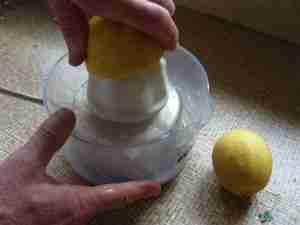
- Orange juice press. Actually I use a hand-press mostly unless more than four or five citrus fruits. So much quicker, simpler and much less to clean; exercise for the arms too.
The nutrients are vastly better if you include the pulp, especially the vitamin C and calcium, so I take out the pips only in the strainer; and then use the hand blender to mush it up.
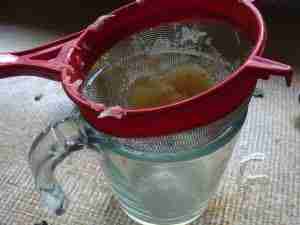
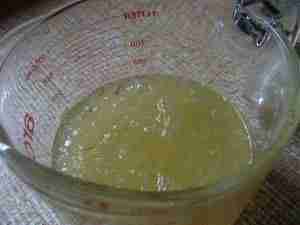
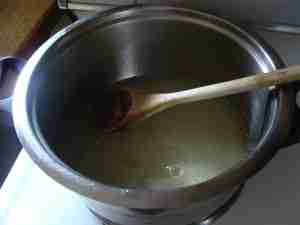
I forgot to take the last photo, the family was in such a hurry to down their juice. Six glasses of lemon-drop drink recipe had already been downed.
Five of the fruit will make 20 or more glasses of our lemon-drop drink recipe, depending on how strong you like it.
Growing lemon trees
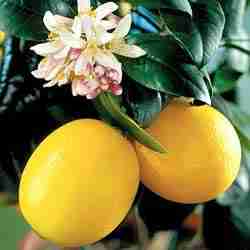
Making this LEMON DROP DRINK RECIPE is really only an option if you have your own tree. The Meyer is such a beautiful plant and, even as a decorative-feature, it fits perfectly into any garden.
Add to that the benefits of fresh juice with your salads. far nicer than vinegar, even Balsamico, and refreshing lemon water. Why not think of planting a Meyer. It is the best, a fairly small-tree perfect even for the tiny garden, and it bears for months.
The scent of those lemon flowers is truly divine. GROWING LEMON TREES ...
Never a day passes when we do not enjoy lemon juice, either as a drink, in our hummus, squeezed over a green salad and dozens of other ways where its piquant flavour adds so much zest to food. We give it a large amount of the credit for the fact that neither she who must be obeyed or I take any medication, quite unusual well over seventy.
Covid-19
It would appear that despite our masks, social-distancing and frenetic cleaning of hands eventually all of us will be exposed to this nasty virus. Those with a strong immune system will most likely get sick, perhaps even very ill but recover. This lemon drop drink recipe will certainly boost your defenses.
Some interestingly have the antibodies and were obviously infected but never got sick at all; their immune systems were so effective that they shrugged it off and the bug never had a chance.
Those who have raised blood glucose are extremely vulnerable to the virus. You will notice that this lemon drop drink recipe is very low in added-sugar; in fact we usually would use none at all, and only a small amount of honey. Avoid all refined carbohydrates at this dangerous period of history.
Do you know that the average South African, and American, consumes half a cup of sugar per day? We think it one of the prime reasons why Covid-19 is running both nations ragged. Raised blood glucose is the prime underlying cause of the inflammatory cytokine storm that the virus features so prominently.
Also take a daily walk in the sun with a hat on; those with low vitamin D have twice the chance of dying from Covid-19. Perhaps it was just because we were indoors more in the long winters. After your stroll take a glass of lemon drop drink recipe and not a cola. The artificial sweeteners in the sugar-free varieties kill the so important microbiota in the colon.
Drink more water; enjoy beverages like this lemon drop drink recipe.
USEFUL LINKs
- Limonin
- Citrustech for more about the citrus fibers
- Drinking water. Web: https://cutt.ly/xQhOsOW
- Glycaemic and insulinaemic properties of some German honeys
When browsing use right click and "Open Link in New Tab" or you may get a bad gateway signal.
Did you find this page interesting? How about forwarding it to a friend, or book and food junkie? Better still, a social mead tick would help.
- Bernard Preston homepage
- Citrus
- Lemon Drop Drink Recipe
Address:
56 Groenekloof Rd,
Hilton, KZN
South Africa
Website:
https://www.bernard-preston.com